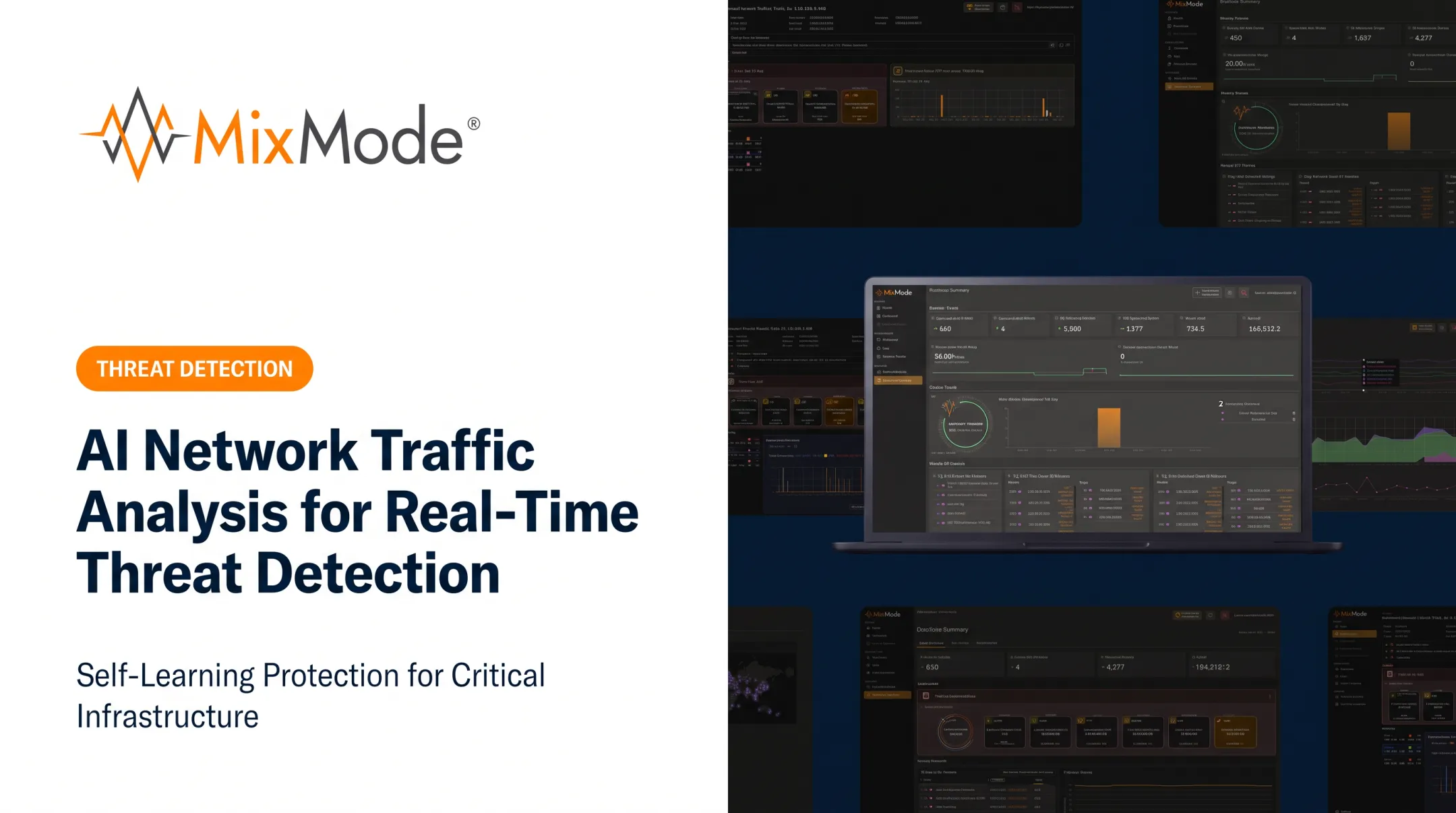
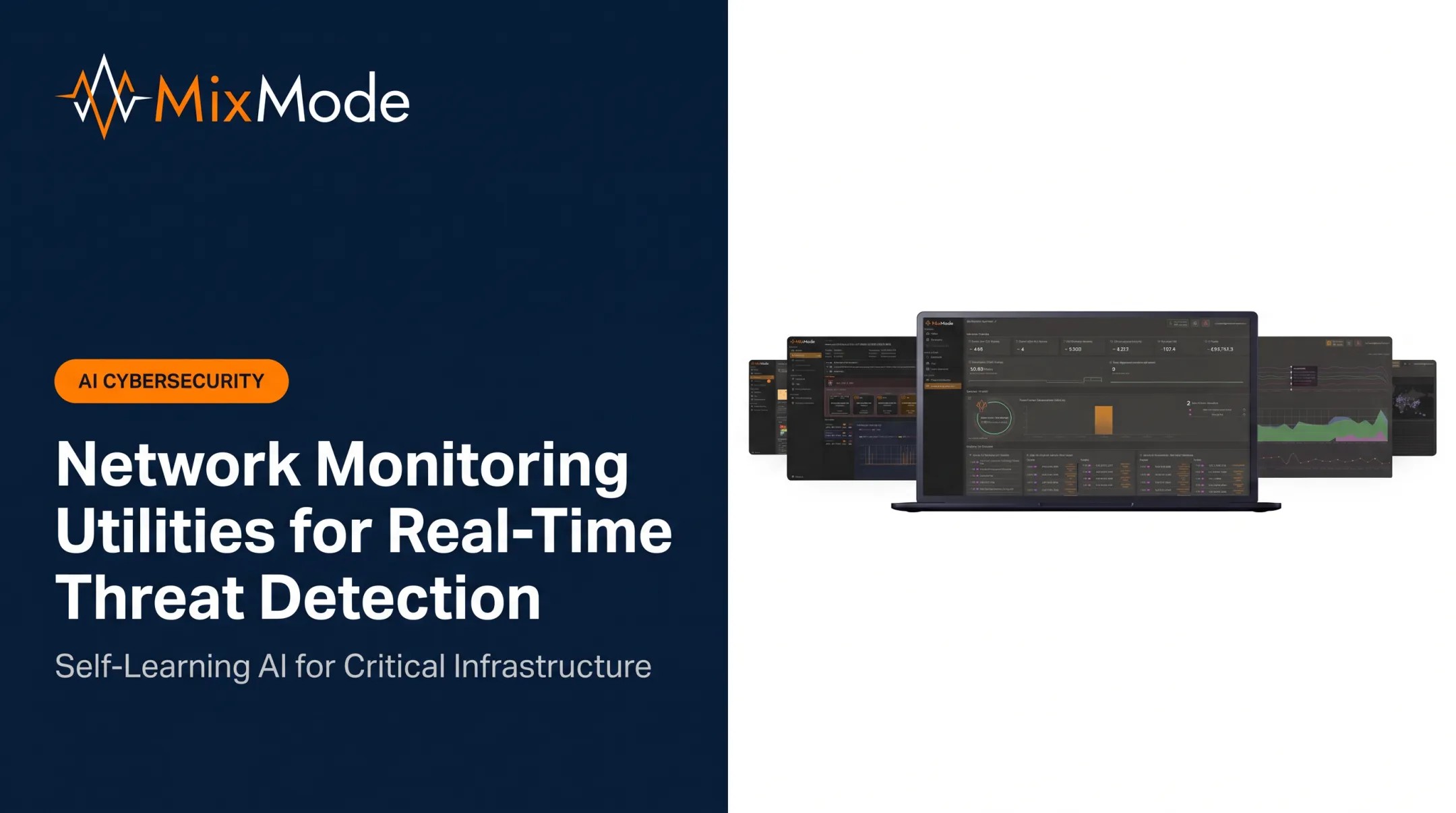
For this article, AI network monitoring means using artificial intelligence, machine learning, and behavioral analysis of network telemetry to identify suspicious activity and operational anomalies as they happen, not after the fact.
This isn't about slapping an "AI" label on legacy tools. We'll cover how AI actually detects threats, where it outperforms rules-based monitoring, which use cases benefit most, and what security leaders should evaluate before choosing a platform.
Key Takeaways
- AI network monitoring learns normal activity patterns and catches deviations static rules miss
- Real-time detection needs quality telemetry, cross-source correlation, and clear alert prioritization
- Effective AI cuts alert fatigue, surfaces pre-attack indicators, and speeds investigation
- Weigh platforms on deployment flexibility, data governance, explainability, and IT/OT coverage
What Is AI Network Monitoring and How Does It Work?
AI network monitoring sits at an intersection of several security disciplines, but it isn't identical to any of them.
How it differs from adjacent categories:
- Network Detection and Response (NDR) uses AI and analytics to monitor east-west and north-south traffic for malicious activity, per Gartner's NDR market definition
- SIEM platforms gather security data from system components into a single interface (NIST), without direct behavioral analysis of network traffic
- Network performance monitoring (NPM) measures quality of service and performance variables, not security threats
- AIOps applies big data and ML to automate IT operations tasks like correlation and anomaly detection, but its focus is operational, not security-specific
These categories overlap in data sources and techniques but serve different operational goals.
How Platforms Build Behavioral Baselines
AI network monitoring platforms ingest data from network flows, cloud traffic, logs, and existing sensors. The MixMode Platform, for example, pulls in Cloud API data, Cloud Flow Logs, and standard log feeds to build what it calls a Network Baseline.
From there, machine learning establishes behavioral baselines for users, devices, applications, and traffic patterns. MixMode's self-supervised AI continuously analyzes real-time network behavior against a dynamically adapting baseline. It adjusts to each organization's infrastructure within days, without rules, training data, or human input.
Rules vs. Adaptive Detection
Rules and signatures work well for known threats. They flag conditions security teams have already seen and codified. The problem: rules can't scale to the complexity of a modern corporate network, and they're blind to anything novel.
Adaptive behavioral detection takes a different approach:
- It identifies relationships and deviations that weren't explicitly programmed in advance
- It adjusts as the network changes, rather than requiring constant rule updates
- It can flag zero-day and AI-generated threats that have no existing signature
MixMode's self-supervised algorithms detect deviations across multiple time scales specifically to catch these novel attack types while minimizing false positives. Continuous learning matters here. A baseline that never updates goes stale fast. One that updates too freely risks attackers slowly shifting behavior to avoid detection. Analyst review and feedback loops remain essential checks on any self-learning system.
Why AI Matters for Real-Time Threat Detection
Rules-based monitoring waits. It waits for a known signature, a manually written rule, or worse, a post-incident forensic review to explain what already happened. Real-time AI analysis flips that: it identifies suspicious behavior as it develops.
Threat Patterns AI Helps Surface
AI-driven behavioral analysis is particularly suited to catching:
- Lateral movement : attackers using valid credentials to hop between systems, including remote-service logins via SSH, per MITRE ATT&CK's lateral movement tactics
- Unusual privilege use and escalation attempts
- Compromised credentials behaving outside normal patterns
- Data exfiltration indicators, including transfers over existing command-and-control channels, as described in MITRE ATT&CK's exfiltration tactics
- Command-and-control activity, often disguised through unusual protocol or port pairings
- Anomalous remote access and unusual IT/OT communications
Connecting the Dots Across an Attack
A single anomaly rarely tells the whole story. AI correlates minor events across devices, users, applications, and time to build a fuller picture of a campaign.
Picture this hypothetical: a finance department laptop authenticates at 2 a.m. from an unusual geographic location, then that same account queries a database it's never touched before, followed by a spike in outbound traffic to an external IP. Individually, each event might not trigger a rule. Together, they paint a clear picture of compromise.
Speed matters once those dots connect. IBM's 2026 Cost of a Data Breach study found organizations making extensive use of security AI and automation averaged 215 days to identify and contain a breach, versus 280 days for those not using it, a 65-day difference reported in IBM's research.
That figure reflects broader security AI and automation use across identification and containment, not an isolated network-monitoring benchmark. Still, it signals that AI-assisted security operations move faster.
Pre-attack indicators and in-progress activity help prioritize where analysts look first. Analysts still need to validate findings against business context and other evidence before anyone triggers a response.
The AI Threat-Detection Workflow
Understanding the end-to-end process helps clarify where AI adds value versus where human judgment stays essential.
From Ingestion to Prioritization
- Telemetry ingestion and enrichment: platforms pull in network flows, cloud logs, authentication data, and existing sensor feeds. MixMode, for instance, ingests Zeek or Corelight telemetry over Kafka without requiring a rip-and-replace of existing infrastructure
- Behavioral modeling: the system builds and continuously updates its baseline of normal activity
- Anomaly scoring: deviations get assigned risk scores (MixMode's platform, for example, assigns scores like 9 or 10 to high-risk outbound traffic anomalies)
- Correlation: related events across systems get linked rather than treated as isolated alerts
- Alert prioritization: the highest-risk, most actionable alerts surface first
- Investigation and response: analysts (or automated playbooks) act on prioritized findings

Why Context Changes Everything
An anomaly on a low-value test server means something very different than the same anomaly on a domain controller. Context that should inform severity includes:
- Asset criticality and business function
- User identity and role
- Network segment
- Historical behavior patterns
- Known, scheduled changes (patches, migrations)
- Relationships between affected systems
Intelligent Alerting Beats Alert Floods
One of AI's biggest practical wins is grouping. Instead of generating a dozen disconnected alerts for one incident touching multiple systems, a well-built platform connects those symptoms into a single probable-incident view.
This matters because of the alternative. IBM's 2023 survey of 1,000 SOC team members found respondents estimated spending 32% of their workday investigating incidents that weren't real threats, according to IBM's Global Security Operations Center study. Intelligent correlation directly attacks that waste.
From Investigation to Response
Good platforms support investigation with supporting evidence, timelines, and affected-asset views, then integrate with SIEM, SOAR, and ticketing systems so findings flow into existing workflows rather than sitting in a separate dashboard.
Response options should range from analyst recommendations to controlled automation such as isolating an endpoint or blocking traffic. For any high-impact action, build in:
- Approval gates before automated actions execute
- Rollback procedures if an action turns out to be wrong
- Audit trails for compliance and after-action review
- Human-in-the-loop checkpoints, especially for OT or safety-critical systems
Real-World Use Cases for AI Network Monitoring
Federal Agencies and Defense
Federal and defense networks face nation-state-grade adversaries across sensitive, often disconnected or tactical infrastructure. The DoD's Zero Trust framework specifically addresses "Denied, Disrupted, Intermittent, and Limited" (DDIL) environments, where systems need local capabilities for disconnected functions, per the DoD Zero Trust Capabilities and Activities documentation.
MixMode's platform for federal deployments installs without requiring internet access, cloud services, or constant external updates, built to operate in isolated facilities and tactical deployments. It holds a Department of War Certificate to Field and an Intelligence Community Authority to Operate.
Critical Infrastructure: Utilities, Energy, and Manufacturing
IT/OT environments carry a unique constraint: you can't just pile on more logging. Joint 2024 guidance from CISA and partner agencies warns that excessive logging can adversely affect resource-constrained OT devices, recommending supplementary sensors instead, according to CISA's event logging and threat detection best practices.
A documented example: Vermont Electric Cooperative selected AI-driven network monitoring specifically for network modeling, process-anomaly detection, and intrusion detection on its ICS environment, as described in a 2017 statement from its operations engineering manager.
In MixMode's own customer base, a major US utility used the platform to gain visibility into state-sponsored intrusions and adversarial AI attacks, reducing false positives by over 95%. The deployment replaced a previous SIEM setup as the utility's core network monitoring system.
Cities, Healthcare, and Enterprise SOCs
Smaller teams face a different problem: too much to watch, not enough people to watch it. ICMA's 2021 article on local-government cybersecurity found 71.4% of surveyed CISOs cited inadequate or insufficiently trained staff as a top barrier, based on a 2020 survey of local-government cybersecurity leaders. Healthcare faces similar strain: the 2023 HIMSS Healthcare Cybersecurity Survey found 74.16% of respondents named recruiting qualified cybersecurity staff a significant workforce challenge.

This is exactly where AI-driven prioritization earns its keep. The City of Phoenix, a MixMode customer, used the platform to connect security signals across multiple systems through intelligent alert correlation. Another municipal customer reduced data-storage costs by 50% while improving detection coverage.
How to Evaluate an AI Network Monitoring Platform
Before signing anything, run candidates through a structured checklist.
Detection Capabilities Checklist
- Does it detect unknown and pre-attack indicators, not just known signatures?
- Does it build and continuously adapt behavioral baselines?
- Does it correlate alerts into probable incidents, or just generate more noise?
- Can it explain why it flagged something? NIST's AI Risk Management Framework ties explainability directly to easier debugging, monitoring, and governance
- Is there independent validation or documented customer evidence behind these claims?
Architecture and Deployment Fit
| Consideration | Questions to Ask |
|---|---|
| Deployment environments | Does it support cloud, hybrid, on-prem, edge, air-gapped, and DDIL? |
| Data governance | Where is data stored? Who controls access and retention? |
| Infrastructure requirements | Does it need GPUs or extensive retraining cycles? |
| OT compatibility | Can it work within resource-constrained device logging limits? |
MixMode, for example, deploys remotely without appliances in under an hour, operates without GPU infrastructure, and is fully containerized for on-premises, cloud, or hybrid use, including air-gapped and DDIL environments.
Integration and Operational Fit
Confirm the platform works with what you already have:
- Existing sensors (Zeek, Corelight, and similar)
- SIEM and SOAR platforms
- Identity and ticketing systems
- IT/OT-specific tooling
Also ask how it handles false-positive feedback, baseline drift after infrastructure changes, and what governance exists around automated response permissions.
Where MixMode fits: MixMode is an AI-first Cybersecurity Intelligence Layer that uses self-learning, self-supervised AI to detect known and unknown threats without relying exclusively on static rules or signatures. It augments existing SIEM, UEBA, and NDR investments rather than requiring a rip-and-replace, and its deployment options span connected enterprise networks through disconnected, air-gapped, and tactical edge environments. You can review deployment specifics on the MixMode Platform page.

Frequently Asked Questions
What's the best AI tool for network security?
The best fit depends on your network architecture, threat model, deployment constraints, data-governance needs, and how much automation your SOC wants. Use the evaluation criteria above rather than chasing a single "best" label.
What are some AI-based network monitoring tools?
Categories include AI-enhanced network monitoring, NDR platforms, SIEM or security analytics tools, and AIOps products. Verify whether a given tool focuses on performance, security, or both before comparing options.
What are network monitoring tools?
These are systems that collect and analyze network, device, application, and traffic data for visibility into availability, performance, and security. Traditional tools use fixed thresholds; AI-enhanced versions adapt to behavioral baselines instead.
What is an AI monitor?
An AI monitor applies machine learning or other AI techniques to detect patterns, anomalies, and potential risks within monitored data. Capabilities and automated-response levels vary significantly from platform to platform.
Can AI monitor your phone?
AI can analyze phone activity when authorized enterprise device-management or network-monitoring software collects that telemetry, such as on a company-issued device. It cannot legitimately monitor a private phone without consent or appropriate administrative controls.