Introduction
Security teams struggle as their networks get bigger and messier at the same time:
- Cloud workloads spin up and down by the hour
- Hybrid infrastructure mixes on-premises gear with SaaS
- IoT sensors and operational technology (OT) systems share networks with corporate laptops
The result: far more network activity than any analyst team can manually review, correlate, or make sense of.
AI in network security addresses this gap. It uses machine learning, behavioral analytics, and automation to study network activity, flag what looks abnormal, rank risks by urgency, and speed up investigation and response.
This article covers how AI-driven detection actually works, where it delivers real value, what limitations you need to manage, and how to evaluate a platform before you buy one.
Key Takeaways
- AI analyzes network behavior and telemetry at scale, catching anomalies that static rules and signatures often miss.
- Strong implementations pair AI with existing visibility tools, threat intelligence, SIEM/SOAR workflows, and human oversight.
- Evaluate vendors on data quality, explainability, deployment flexibility, integrations, governance, and measurable outcomes, not marketing claims.
What AI in Network Security Means
AI in network security refers to machine learning, behavioral analytics, pattern recognition, natural-language interfaces, and automation applied to network monitoring and threat identification. Instead of just matching traffic against known attack patterns, these systems learn what "normal" looks like for a specific environment and flag meaningful departures from it.
Signatures vs. Behavior
Traditional controls rely on signatures: known malware hashes, bad IP addresses, attack patterns, and command-and-control domains. The National Institute of Standards and Technology notes that signature-based detection is effective against previously documented threats but struggles against unknown ones. Anomaly-based detection takes a different approach, building a profile of typical activity and surfacing deviations.
AI extends this concept. It can model relationships across thousands of events simultaneously, something rules engines simply aren't built to do.
AI Augments, Doesn't Replace
AI doesn't eliminate the need for layered security controls. It works alongside:
- Firewalls and intrusion detection/prevention systems
- Identity and access management controls
- Endpoint security tools
- Network detection and response (NDR) platforms
- SIEM and SOAR workflows
- Zero trust architectures
AI acts as an intelligence layer across these tools, connecting signals that would otherwise stay siloed in separate consoles.
How AI Works in Network Security
Collecting and Normalizing Data
AI systems ingest network flows, authentication events, endpoint signals, cloud logs, and IT/OT telemetry. Platforms like MixMode pull in enriched telemetry from CrowdStrike Falcon, firewalls, CloudTrail, syslog, and raw network traffic. They can also ingest existing Zeek or Corelight data over Kafka without a rip-and-replace of current sensors.
More data sources mean more context. But raw volume alone isn't the goal. Quality and relevance of the data matter more than quantity.
Building a Behavioral Baseline
Instead of assuming every network looks the same, AI models learn what's typical for a specific environment, users, devices, applications, and segments, based on actual observed activity. There's no universal definition of "normal" traffic.
Some platforms require weeks of baselining before they're useful. MixMode's self-learning approach starts modeling an environment immediately upon deployment, adapting within days rather than requiring a lengthy training period.
Detecting Anomalies and Connecting Weak Signals
A single unusual login isn't necessarily an attack. But an unusual login, followed by unexpected lateral movement, followed by an odd outbound connection, starts telling a story. AI correlates these weak signals into a higher-context picture, surfacing things like:
- Reconnaissance activity ahead of an attack
- Lateral movement between systems
- Command-and-control communication patterns
- Indicators of data exfiltration
Risk Scoring and Prioritization
Not every anomaly deserves equal attention. NIST's incident response guidance recommends triaging events based on asset criticality, functional impact, observed attack stage, and recoverability, rather than handling alerts first-come, first-served.
That context, not just a raw anomaly score, is what separates a material incident from benign variation.
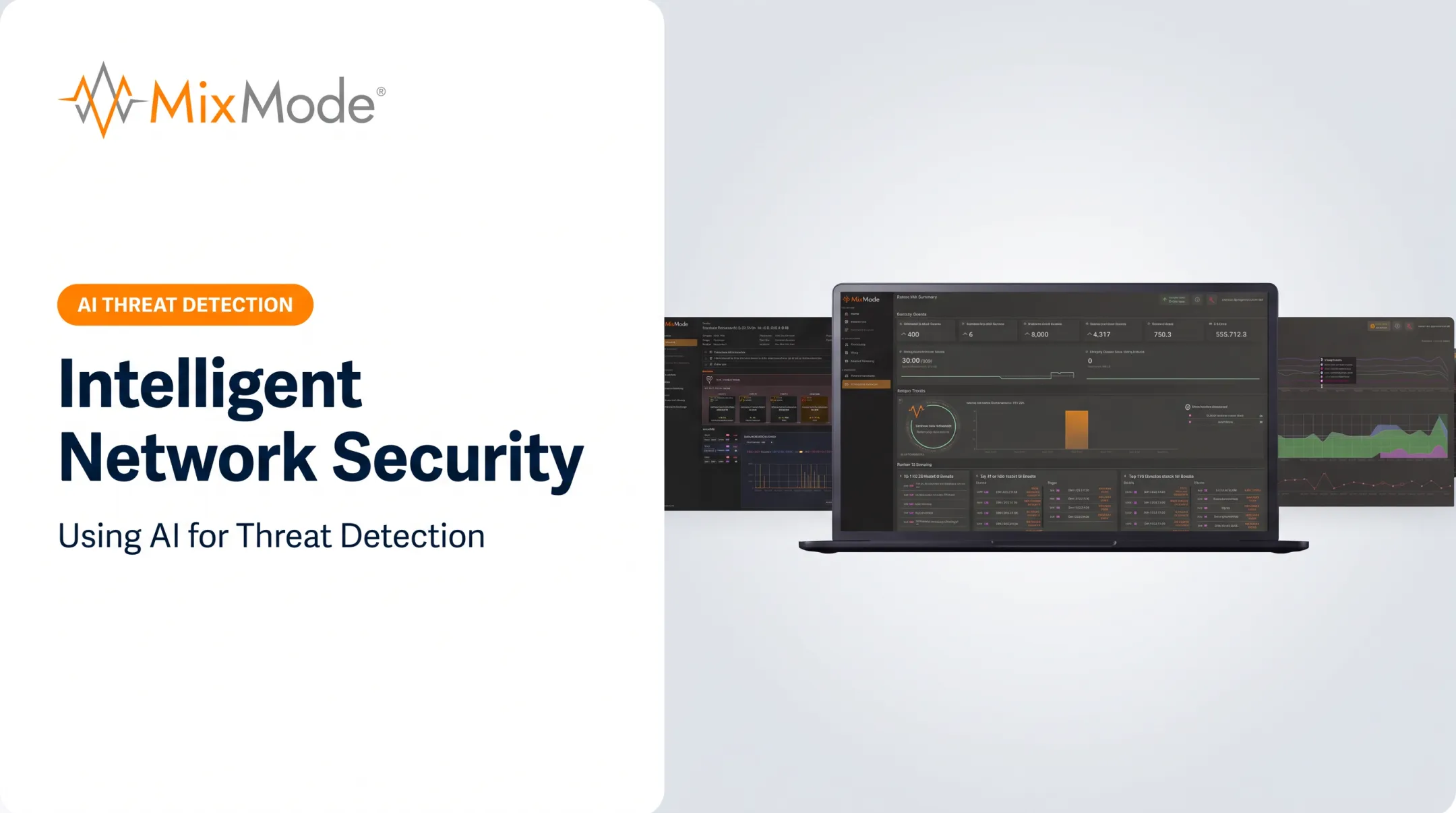
MixMode's dashboard, as one example, assigns risk scores to flagged entities and weighs them against environmental context, helping analysts decide what to investigate first.
Response and Orchestration
Once something suspicious surfaces, AI can recommend next steps: investigate further, enrich with threat intelligence, block traffic, isolate a device, or escalate to a human analyst.
Human-approved automation (analyst sign-off before action) differs from fully autonomous response (the system acts on its own). Most mature deployments start with the former and expand automation carefully as trust builds.

MixMode operates as a context-aware, self-learning Cybersecurity Intelligence Layer that detects known and unknown threats across connected, hybrid, on-premises, edge, air-gapped, and DDIL environments, without GPUs or signature libraries.
Benefits and Use Cases of AI in Network Security
Catching Novel and Zero-Day Activity
Signature matching can't catch what it's never seen. Behavioral detection looks at relationships and patterns instead. This matters more than ever: Google's Threat Intelligence group tracked 90 exploited zero-day vulnerabilities disclosed in 2025, including 14 affecting edge devices, many of which lack endpoint telemetry entirely. Network-level behavioral monitoring fills that visibility gap.
Reducing Alert Fatigue
False positives wear teams down. SANS found that 73% of detection-and-response survey respondents in 2025 cited false positives as a significant challenge, up from 64% the year before. AI-driven correlation can suppress duplicate and low-value signals, surfacing fewer but more meaningful investigations.
As one data point from MixMode's deployment experience: a major U.S. utility reduced false positives by over 95% after implementing MixMode's AI-driven platform for critical infrastructure monitoring.
Proactive Threat Hunting
Beyond reactive alerting, AI supports hunting for pre-attack indicators, reconnaissance, insider misuse, and ransomware behavior before it causes damage. MixMode's platform, for instance, forecasts expected network behavior and flags both unusual activity and the absence of expected activity, a signal that's easy for human analysts to miss.
Scaling Across Complex Environments
Organizations running cloud, hybrid, multi-site, or OT environments generate telemetry volumes no analyst team can manually parse. MixMode's platform is built to analyze over 100 Gbps of network traffic or billions of records monthly across enterprise, OT, and cloud environments.

Use Cases by Sector
| Sector | Why AI-driven detection matters |
|---|---|
| Federal & defense | Needs detection of novel, nation-state-grade threats across sensitive, often air-gapped networks |
| Utilities & energy | OT/IT convergence creates risk where downtime isn't an option |
| Manufacturing | Production lines and connected equipment are prime ransomware targets |
| Healthcare | Large volumes of connected medical devices and patient data systems |
| Cities & local government | Small security teams, aging infrastructure, limited budgets |
| Enterprise SOCs | Existing SIEM investments need an AI layer to catch what rules miss |
CISA's advisory on Volt Typhoon activity targeting U.S. critical infrastructure specifically calls for network-management baselines, behavioral analytics, anomaly detection, and active threat hunting, confirming that this isn't theoretical guidance, it's a response to real, observed intrusions in energy, water, and transportation sectors.
Complementing Existing Tools
AI doesn't need to replace SIEM, SOAR, NDR, or endpoint tools. The strongest deployments integrate bidirectionally, feeding enriched findings into existing workflows rather than forcing analysts to learn a new console. MixMode, for example, integrates with SIEM and SOAR platforms and threat-intelligence feeds rather than requiring an immediate rip-and-replace.
Challenges, Risks, and Governance
Data Quality Problems Undermine Everything
An AI system is only as good as what it sees. Incomplete visibility, inconsistent telemetry, and gaps in coverage all produce unreliable conclusions. Model drift, where a baseline becomes stale as the environment changes, is a related risk that requires ongoing validation.
Attackers Target AI Too
Defensive AI isn't immune to abuse. NIST's adversarial machine learning taxonomy covers evasion techniques and data poisoning attacks aimed at network intrusion and traffic-anomaly detection systems. Attackers can also craft synthetic activity designed to resemble normal behavior, slipping past baseline models.
Governance Requirements
Before expanding automation, organizations need:
- Defined automation boundaries - what the system can act on independently versus what requires human sign-off
- Audit trails - documented evidence of every decision and action
- Model validation - testing before deployment and on an ongoing basis
- Access controls - documented and enforced for sensitive telemetry
- Accountability - a named human owner for high-impact decisions
Explainability Matters
An analyst shouldn't have to take an AI's word for it. Every alert should come with supporting evidence:
- What behavior triggered it
- How it compares to baseline
- Which related signals contributed to the score
- Which assets are involved
Analysts need the ability to challenge or validate a conclusion, not just accept it. MixMode's AI Assistant, for example, is built to triage alerts and explain the reasoning behind each prioritization decision.
Operational Constraints
Legacy tools, air-gapped networks, strict privacy requirements, and limited staffing all shape what's realistic. A platform that demands constant cloud connectivity or GPU infrastructure simply won't work in a disconnected or tactical environment. That constraint is why deployment flexibility matters so much in vendor selection.
How to Evaluate and Implement AI Network Security
Start With an Honest Assessment
Before evaluating vendors, inventory what you actually have:
- Network segments, cloud accounts, and endpoints
- Identity sources and OT assets
- Existing security controls and telemetry gaps
- The specific security outcomes you want to improve
Build a Vendor Checklist
Your evaluation should cover:
- Detection scope for both known and unknown threats
- Behavioral modeling approach and baseline speed
- Alert prioritization and explainability
- Investigation workflows and response controls
- Support for emerging attack techniques
Assess Deployment Requirements
Ask directly:
- Does it require appliances, agents, or GPU infrastructure?
- Can it operate in air-gapped or DDIL environments?
- Does it require continuous connectivity or periodic retraining?
NIST's OT security guidance notes that active scanning can disrupt sensitive industrial processes, so passive monitoring options matter for converged IT/OT environments.
Validate Integrations With a Proof of Concept
Test the platform against your SIEM, SOAR, NDR, XDR, identity, and ticketing systems using representative data and realistic attack scenarios, not vendor demo data.
Define Success Before You Deploy
Set baseline measurements for:
- Mean-time-to-detect
- Alert volume and analyst workload
- Breadth of visibility across segments
- Time to identify suspicious activity
Vendor-reported metrics should be independently validated against your own environment, not taken at face value.

Organizations exploring this space often look at MixMode as one example of a rules-free, self-supervised AI layer built to integrate with existing security operations and deploy across cloud, on-premises, edge, and air-gapped environments. Review current product materials directly rather than relying on third-party comparisons alone.
Conclusion
AI gives network security teams a way to analyze complex behavior, connect scattered signals, and prioritize action faster than manual review ever could. But none of that works without visibility into the right data, governance that keeps humans accountable, and analysts who can trust and verify what the system tells them.
Practical next steps:
- Start with a specific security problem you need to solve
- Test any AI platform against real network conditions, not a sanitized demo
- Keep humans in the loop for high-impact decisions
- Expand automation only once results are explainable and measurable
Frequently Asked Questions
How is AI used in network security?
AI monitors network behavior, detects anomalies, correlates threat signals, and prioritizes alerts by risk. It also supports proactive threat hunting and can recommend or trigger analyst-approved response actions.
Which AI is best for network security?
There's no single best model. The right approach depends on your environment, data sources, deployment constraints, integration needs, and how much automation you're ready to trust.
What are the benefits of AI in network security?
AI helps detect unknown or subtle threats, scales analysis across massive telemetry volumes, reduces alert fatigue, and speeds up investigation. It also improves visibility across hybrid and OT environments.
Can AI detect unknown threats on a network?
Yes, behavioral and anomaly-based systems can flag activity that doesn't match any known signature. Detection quality still depends on visibility, context, and ongoing model validation.
What are the risks of using AI in network security?
Key risks include poor data quality, false positives, model drift, adversarial evasion, data poisoning, and gaps in explainability. Over-relying on automation without human oversight adds further risk.