Grid security infrastructure is bigger than firewalls or control-room software. It spans asset visibility, IT/OT monitoring, access controls, threat detection, incident response, and resilience planning working together.
Many security teams struggle most with what happens after perimeter defenses are bypassed. This article focuses on catching threats early, spotting activity hiding inside trusted environments, and strengthening protection without disrupting operations that can't afford downtime.
Key Takeaways
- Grid security covers IT, OT, DER, and communications layers, not just firewalls or SCADA software
- Lateral movement from IT to OT systems is the most dangerous and hardest-to-spot attack phase
- Asset discovery and behavioral baselines matter more than signature-based detection alone
- Zero Trust principles can apply to OT without requiring constant re-authentication of field devices
- Detection must integrate with existing SOC, SIEM, and incident-response workflows to be useful
Grid Security Infrastructure: Components and Scope
Grid infrastructure refers to the physical and digital systems that generate, transmit, distribute, and deliver electricity: power plants, substations, transmission lines, control centers, field devices, and customer-facing systems.
Grid security infrastructure is the layer protecting all of it. The two terms get used interchangeably, but they're not the same thing.
What Falls Under Grid Security Infrastructure
Effective protection spans three distinct digital and operational environments:
- Enterprise IT systems: cloud services, identity platforms, remote-access tools, and corporate networks
- OT environments: SCADA, industrial control systems, PLCs, RTUs, engineering workstations, and protective relays
- Edge and field systems: smart meters, IoT sensors, distributed energy resources, EV charging infrastructure, and communications networks
Each layer has different risk tolerances, different update cycles, and different consequences when something goes wrong.
Why the Attack Surface Keeps Growing
IT/OT convergence means systems that were once air-gapped now talk to corporate networks and cloud services. Add distributed energy resources, mobile field crews, third-party vendors with remote access, and legacy equipment that can't be patched without a planned outage, and the attack surface expands faster than most security teams can map it.
Security objectives for grid operators differ from standard enterprise IT:
- Preserve availability and physical safety above all else
- Protect the integrity of measurements and commands sent to field equipment
- Maintain confidentiality where it matters, without treating it as the top priority
- Support reliable recovery when something does go wrong
Traditional IT controls don't always translate. A vulnerability scan that's routine on a corporate laptop can destabilize a protective relay. Long asset lifecycles (some equipment runs for 20+ years) and narrow maintenance windows mean grid security has to work around operational constraints, not against them.
The Threat Landscape: How Critical Systems Are Targeted
Most successful attacks don't start with a dramatic breach. They start quietly: reconnaissance, stolen credentials, a foothold in an exposed service. From there, attackers escalate privileges, move laterally, and work toward manipulation, disruption, or persistence.
Detecting that early-stage activity, before it reaches operational systems, is the difference between an incident report and a blackout.
Threat Categories Facing Grid Operators
- Ransomware, malware, and phishing entering through enterprise systems or compromised vendor accounts
- False-data injection and command manipulation that distorts what operators see on their screens
- DDoS and communications disruption that knocks out monitoring or remote-access availability
- Insider misuse and contractor risk, including employees or vendors with legitimate but misused access
- Physical sabotage coordinated with cyber activity, where hybrid attacks target the same facility from two directions
Lateral movement deserves particular attention. The 2024 Volt Typhoon advisory from CISA and partner agencies documented a nation-state actor moving from compromised IT infrastructure toward control systems, positioning for potential disruption rather than executing one immediately.
That distinction matters: observed access and confirmed outage are not the same thing, but pre-positioning is still a serious signal.

Hiding in Plain Sight
Abnormal activity often looks almost normal. Common examples include:
- Device-to-device communication over a legitimate industrial protocol
- Administrative logins outside normal shift hours
- Slight upticks in traffic to an unfamiliar destination
None of it triggers a signature-based alert. It just looks like noise, which is exactly the point.
How to Detect Threats Across Grid Infrastructure
Perimeter detection answers one question: who's trying to get in? It doesn't answer the harder question — what's already moving around inside?
Monitoring north-south traffic alone misses lateral movement across substations, control networks, and vendor pathways. That's where most grid compromises actually happen.
Asset Discovery and Behavioral Baselines
You can't detect a deviation from normal if you don't know what normal looks like. CISA's 2025 asset inventory guidance calls for a regularly updated device inventory, classified by function and importance, with documented communication pathways between zones.
Effective baselining requires:
- Identifying every device: known, unknown, unmanaged, and newly connected
- Documenting expected relationships between control systems, field devices, engineering workstations, and monitoring platforms
- Flagging deviations in protocols, ports, destinations, frequency, or command behavior
The telemetry that makes this possible includes network flows, DNS activity, identity logs, endpoint signals, industrial protocol metadata, and remote-access records.
What Context-Aware Detection Looks Like in Practice
Static signatures catch known threats. They miss everything else. Behavioral modeling, by contrast, can flag activity that's never been seen before simply because it doesn't match the environment's established pattern.
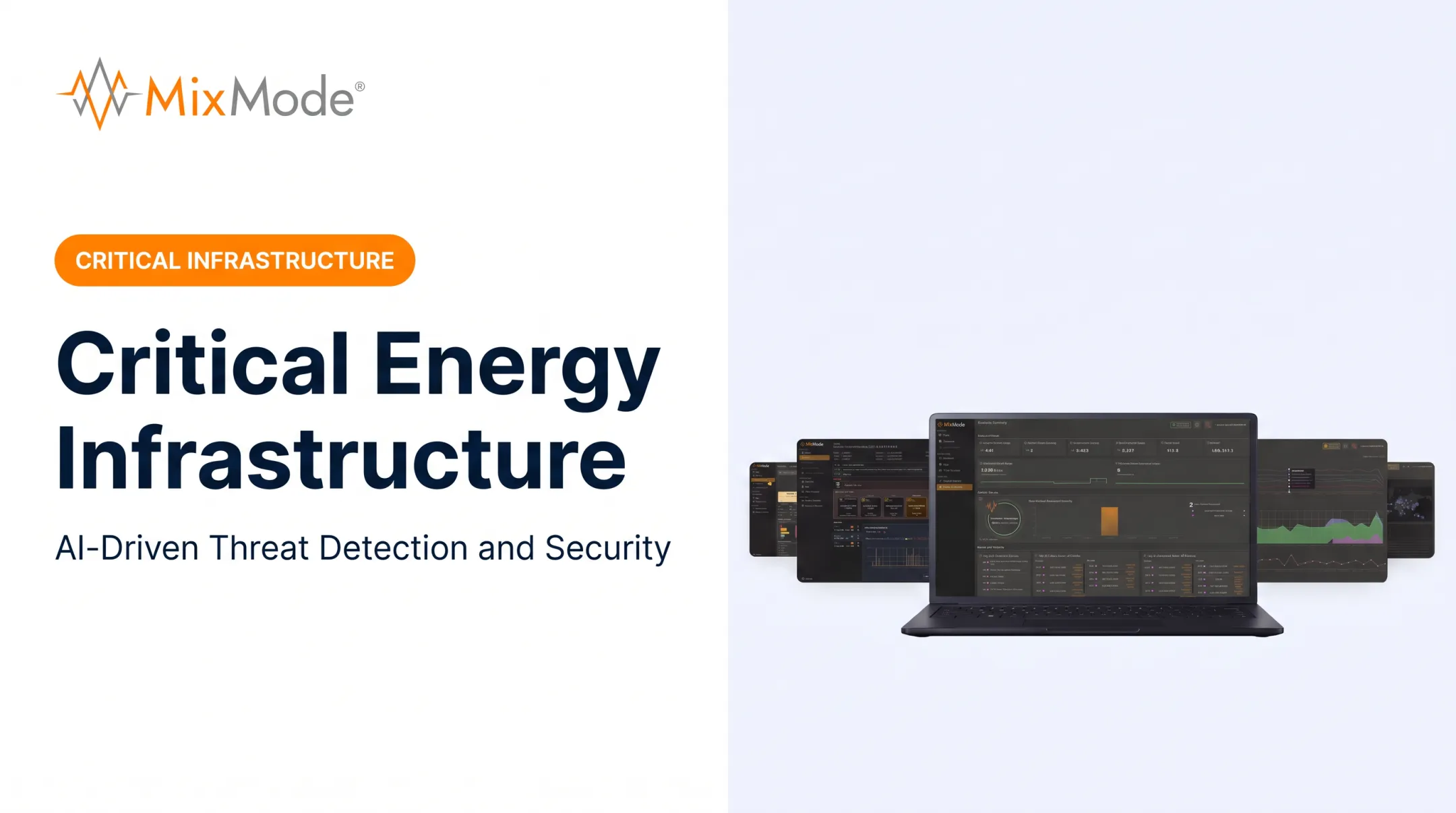
MixMode's Cybersecurity Intelligence Layer is one example of this approach applied to grid environments. It builds a continuous behavioral model of IT and OT activity without relying on manually maintained rules, and it's designed to integrate with existing SIEM and orchestration tools rather than replace them.
The platform supports connected, disconnected, edge, and air-gapped deployments, which matters for utilities running isolated OT segments alongside cloud-connected enterprise systems.
In one deployment with a major U.S. utility, this type of detection layer identified state-sponsored intrusion attempts and adversarial AI activity, while cutting false positives by over 95%. That reduction matters for security teams that can't staff a 24/7 SOC the way a large enterprise can.

Triaging a Detection
When something fires, analysts should:
- Validate the affected asset and confirm it's real, not a sensor artifact
- Determine whether the behavior is operationally expected (a scheduled maintenance window, for instance)
- Correlate related activity across IT and OT logs
- Assess the potential blast radius if the activity is malicious
- Escalate according to the incident-response plan
Building a Layered Grid Security Architecture
Defense in depth coordinates segmentation, identity, monitoring, hardening, and recovery as one system, not a shopping list of disconnected tools.
Core Technical Controls
- Network segmentation between enterprise IT, OT zones, substations, and vendor access paths
- Least privilege access, limiting what any single account or device can reach
- Multifactor authentication where operationally feasible (not every field device supports it)
- Secure remote access for vendors and contractors, with session recording and time-limited credentials
- Encryption for data in transit, where latency and protocol constraints allow it
Legacy systems complicate all of this. When patching isn't safe or available, compensating controls (network isolation, enhanced monitoring, and strict access limits) have to fill the gap.
Zero Trust for OT Environments
Zero Trust in an OT context means continuously validating users, devices, and requested actions rather than re-authenticating a relay every few seconds or treating anything inside the perimeter as automatically trustworthy.
Monitoring access patterns and authentication behavior anchors that validation, especially for engineering workstations with elevated privileges.
NIST's SP 800-82 Revision 3, finalized in 2023, frames OT security as layered defense across people, process, and technology, with segmentation called out as a core requirement. For utilities specifically, NERC CIP-013 governs supply-chain risk for applicable high- and medium-impact systems, and ISA/IEC 62443 provides zone-and-conduit segmentation guidance for industrial control environments.

None of these frameworks replace each other; they are complementary layers addressing different parts of the same problem.
A Practical Implementation Roadmap
Start with governance, not technology. Identify critical functions, map dependencies, assign IT and OT ownership clearly, and rank assets by safety and reliability impact, not just by how expensive they are to replace.
Build the Baseline Before You Tune Anything
Establish normal behavior across users, devices, applications, and system relationships before setting alert thresholds. One utility working with MixMode had the platform deployed within hours and a working model of normal network behavior within minutes, a useful reminder that baselining doesn't have to take months to start delivering value.
Priority visibility improvements include:
- East-west traffic monitoring across substations and control zones
- Vendor and remote-access oversight
- Unknown-asset discovery
- Correlation between IT and OT events, rather than treating them as separate alert streams
Test It Before You Need It
Tabletop exercises and technical simulations should include loss-of-communications scenarios, compromised credentials, OT disruption, and recovery under constraint, not just clean, best-case incident drills.
Finally, make sure detections feed into existing SOC, SIEM, and SOAR workflows. A security team doesn't need another isolated alert stream. They need prioritized, correlated context that tells them what matters and why.
Conclusion: Moving From Visibility to Resilience
Grid security succeeds when teams catch suspicious behavior before it becomes an operational event. Perimeter blocking alone is not enough.
The sequence holds up regardless of utility size:
- Understand your critical assets
- Monitor IT/OT behavior internally
- Flag deviations with real context
- Respond through a tested plan
- Keep refining the process
AI-assisted, context-aware detection (the kind MixMode builds for utilities, federal agencies, and other critical-infrastructure operators) gives security teams a way to catch unknown threats without adding friction to systems that simply can't go down.
Frequently Asked Questions
What is grid security?
Grid security is the protection of electric generation, transmission, distribution, control, and communications systems from cyber, physical, operational, and hybrid threats. It covers both the digital infrastructure and the physical equipment it controls.
What are the main types of grid security?
The main categories are cybersecurity, physical security, operational technology (OT) security, communications security, supply-chain security, and resilience or recovery planning. Most mature programs address all six together.
What is grid infrastructure?
Grid infrastructure is the full set of physical and digital systems that generate, transmit, distribute, monitor, control, and deliver electricity. It includes power plants, substations, transmission lines, field devices, and customer-facing systems.
How do you detect threats in grid infrastructure?
Detection relies on asset inventory, IT/OT visibility, east-west traffic monitoring, behavioral baselines, and identity telemetry. Anomaly detection tied to incident-response workflows turns raw signals into actionable alerts.
Why is OT security important for the electric grid?
OT systems control the physical processes that keep power flowing. A compromise can affect safety, equipment integrity, and service continuity, with consequences that extend to every other critical-infrastructure sector depending on electricity.