Security teams increasingly admit they can't see enough of that trail. Firewalls watch the perimeter. Endpoint tools watch devices with agents installed. Neither sees everything moving between workloads, across clouds, or through unmanaged devices that never get an agent in the first place.
The scale problem is real. A 2025 SANS survey found 76% of organizations now operate across multiple clouds, and nearly half admit they lack centralized visibility and control, according to SANS's multicloud survey. That gap is exactly where attackers hide - in east-west traffic, encrypted sessions, and lateral movement that perimeter logs never capture.
This guide breaks down what network traffic analysis tools actually do, how they turn raw communications into usable threat signals, and which capabilities matter most when you're evaluating one for your own environment.
Key Takeaways
- Network traffic analysis inspects packets, flows, and metadata to catch behavior that endpoint and perimeter tools miss
- The core workflow: collect traffic, enrich it with context, baseline normal behavior, detect anomalies, support investigation
- Tools range from Wireshark and tcpdump to enterprise NTA/NDR platforms built for continuous, large-scale detection
- Effective tools span on-premises, cloud, hybrid, remote, and OT environments and plug into existing SIEM and SOAR workflows
What Is Network Traffic Analysis?
Network traffic analysis (NTA) is the continuous or on-demand examination of communications between users, devices, applications, services, and external destinations. It looks at performance and behavior together, flagging when a relationship between two systems doesn't match what's expected.
The gap it closes is specific. Security teams need to know what's actually talking to what, how often, over which protocols, and whether any of that is new. A firewall log tells you a connection was allowed. It doesn't tell you that a finance server has suddenly started talking to a host it's never contacted before.
What It's Not
NTA gets confused with adjacent technologies. Worth separating:
- Bandwidth or SNMP monitoring tracks link health and utilization, not security behavior
- Firewall logging records allow/deny decisions, not communication patterns over time
- Packet capture alone stores data but doesn't analyze it
- Endpoint detection watches devices with agents installed, missing anything unmanaged
These technologies complement NTA rather than replace it. A SIEM correlating firewall logs with NTA-generated behavioral alerts is stronger than either working alone.
Three Categories of Tools
- Packet analyzers - Wireshark, TShark, and tcpdump inspect traffic at the byte level; strong for troubleshooting and forensics, less practical for continuous monitoring at scale
- Flow and metadata tools - NetFlow, IPFIX, and cloud flow logs summarize who talked to whom, when, and how much, without storing full payloads
- Enterprise NTA/NDR platforms - NDR solutions that combine traffic telemetry with behavioral analytics, threat intelligence, and response integrations across an entire environment
Why does this still matter as infrastructure moves to cloud and remote access? Because the readable payload security teams used to rely on is disappearing.
According to Zscaler's 2024 ThreatLabz report, 87.2% of blocked attacks arrived over encrypted channels. Content inspection still has a place, but detection increasingly depends on timing, volume, destination, and certificate behavior rather than payload alone.

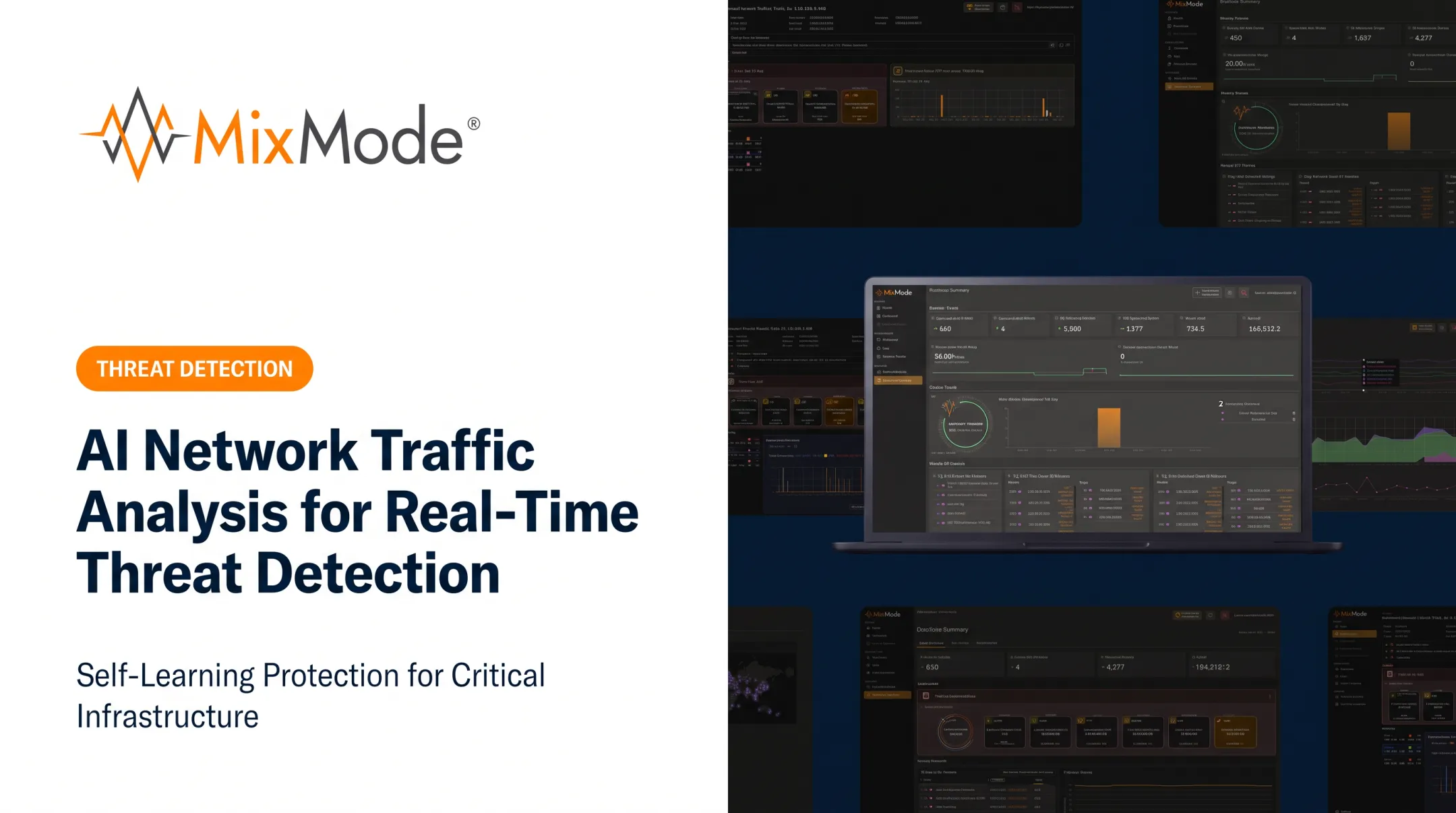
MixMode's network traffic analysis capability is built around that reality: it maps communication patterns, protocols, and data flows across an environment to build context, rather than depending on decrypting every session to find something wrong.
How Does Network Traffic Analysis Work?
NTA works as a pipeline. Tools collect raw communications, process them into analyzable form, compare them against a behavioral baseline, and turn mismatches into findings an analyst can act on.
Data Collection and Visibility
Tools pull traffic or telemetry from multiple sources: packet capture, network TAPs, SPAN or port mirroring, NetFlow and other flow records, firewall logs, cloud flow logs, and DNS data.
Each source trades fidelity for scale:
- Full packet capture - highest detail, heaviest storage and processing cost
- Sampled flow data - lighter footprint, loses packet-level detail
- Metadata-only - fastest to process, least forensic depth
Full packet capture suits deep troubleshooting and post-incident forensics. Flow and metadata suit continuous, large-scale threat detection where storing every byte isn't practical.
Coverage matters as much as the data type itself. A tool watching only north-south traffic at the perimeter misses east-west movement between servers, cloud-to-cloud communication, and traffic from unmanaged devices.
MixMode's platform, for instance, analyzes over 100 Gbps of traffic or billions of records monthly across enterprise, cloud, OT, and mission-critical environments without requiring appliances at every segment.
Traffic Processing and Context Enrichment
Raw packets or flow records get normalized into sessions with extracted fields: source and destination, ports, protocols, timing, volume, certificates, domains, and frequency.
Normalization alone isn't useful. Enrichment turns an IP address into something investigable by tying activity to specific assets, users, applications, known vulnerabilities, and threat intelligence.
An analyst told "10.2.4.18 talked to an external IP" gets nowhere fast. An analyst told "the finance server, which normally talks to three internal hosts, just opened a connection to an IP flagged in threat intel" can act immediately.
This matters even when traffic is encrypted. Tools can't read inside a TLS session, but they can still flag suspicious behavior from metadata: unusual timing, a new destination with a self-signed certificate, abnormal data volume on a connection that normally carries small requests. None of this requires decrypting the session, and no credible tool claims to decrypt everything.
Behavioral Baselines and Anomaly Detection
Before a tool can spot something abnormal, it has to know what normal looks like. Behavioral analytics build that picture over time, for individual devices, users, applications, network segments, and the relationships between them.
Deviations from that baseline can surface:
- Pre-attack reconnaissance, such as port scanning or unusual DNS lookups
- Remote access at odd hours or from new locations
- New external destinations a host has never contacted
- Abnormal data transfer volume in either direction
- Administrative protocols appearing where they shouldn't
- Beaconing patterns consistent with command-and-control traffic
Static signatures still matter for known indicators - a known-bad IP is still a known-bad IP. But rules can't catch what they've never seen, and attackers know it. Adaptive, self-learning analysis closes that gap by flagging behavior that's statistically abnormal, regardless of whether a signature exists for it yet.
This is the premise behind MixMode's Cybersecurity Intelligence Layer: a self-learning, context-aware model that continuously builds its own understanding of normal network behavior rather than depending on pre-written rules or retrained models, aiming to catch both familiar attack techniques and ones nobody has cataloged yet.
Detection, Investigation, and Response
A single weak signal rarely justifies an alert. Real value comes from correlating multiple weak signals - an unusual login, an internal scan, a new outbound connection - into one coherent attack narrative instead of three disconnected noise events.
Once a finding surfaces, the analyst workflow typically follows this pattern:
- Validate the finding against available context
- Identify affected systems and users tied to the activity
- Reconstruct the communication timeline across the incident
- Determine whether activity spread laterally inside the network
- Scope potential data access or exfiltration

Integrations with SIEM, SOAR, endpoint, identity, and firewall tools let that investigation become containment: isolating a host, blocking a destination, disabling a compromised account, or escalating to a formal incident.
The real payoff shows up in investigation quality, not dashboard volume. Forrester's 2025 evaluation of network analysis and visibility solutions points directly at alert fatigue and the need for explainable detections as the issues buyers care about most. A platform that reduces noise while preserving context is doing its job; one that just adds alerts to a queue isn't.
Where Is Network Traffic Analysis Used?
SOC teams use traffic analysis for continuous monitoring, threat hunting, incident investigation, and validating activity that other controls can't fully explain. A few scenarios show where that investment pays off.
Representative detection scenarios:
- Ransomware and lateral movement: internal scanning, unusual admin protocol use, credential abuse, and rapid host-to-host shifts often appear before or during encryption
- Command-and-control: periodic beaconing, unusual destinations, protocol misuse, domain anomalies, and encrypted connections whose metadata breaks normal patterns
- Insider threats and exfiltration: unusual access paths, unexpected external destinations, abnormal outbound volume, and behavior that diverges from a user's baseline
- Cloud, hybrid, and IT/OT environments: workload-to-workload traffic, remote access sessions, and converged operational networks that were previously under-observed
Detection failures show why visibility alone isn't enough. In a 2024 assessment of a federal civilian organization, CISA's red team found that defenders failed to flag 8 GB of continuous traffic from a malfunctioning command-and-control implant over a single afternoon, per CISA's 2024 assessment. The traffic was fully observable. It simply never got classified as anomalous.
Deployment Considerations
Large enterprises, federal agencies, utilities, manufacturers, healthcare organizations, and municipalities each bring different constraints:
- Government and defense environments often need disconnected, edge, or air-gapped (DDIL) deployments with no cloud dependency
- Utilities and manufacturers need visibility across converged IT/OT networks without adding traffic to sensitive control systems
- Healthcare organizations need to baseline connected medical device communication, since many devices can't run an agent
- Smaller municipal IT teams often need enterprise-grade detection without the headcount to run a large SOC
MixMode has been deployed across these settings, from utility operators like the Los Angeles Department of Water and Power to municipal governments including the City of Phoenix and City of Dallas. That coverage spans connected enterprise networks and air-gapped, mission-critical environments.

A Quick Selection Checklist
Before choosing a tool, check for:
- Network and cloud coverage across the full environment, not just the perimeter
- Packet or flow visibility appropriate to your use case - troubleshooting versus continuous detection
- Encrypted-traffic analysis through metadata and behavior, not just payload inspection
- Behavioral detection that adapts, rather than relying solely on static rules
- Historical retention sufficient for forensic investigation
- SIEM/SOAR integration and deployment flexibility across cloud, hybrid, on-prem, and edge
Conclusion
Network traffic analysis is a visibility and analytics discipline that helps security teams understand how systems actually relate to each other and notice when that relationship changes. It goes well beyond packet capture or bandwidth monitoring alone.
Applied well, it supports security operations in concrete ways:
- Catching reconnaissance and lateral movement earlier
- Giving analysts richer context during investigation
- Enabling proactive threat hunting
- Working alongside existing SIEM, SOAR, and endpoint tools
The right tool depends on your architecture, your data sources, and how your analysts actually work, not a feature checklist. Organizations looking for self-learning analysis that spans cloud, hybrid, on-premises, edge, and disconnected environments may find MixMode's approach worth evaluating alongside other options.
Frequently Asked Questions
What tools are commonly used for network traffic analysis?
Common options include packet analyzers like Wireshark and tcpdump, flow and metadata tools, network TAPs and SPAN ports, and enterprise NTA/NDR platforms. The right choice depends on whether you need troubleshooting, forensics, continuous monitoring, or active threat detection.
What is traffic analysis in networking?
Traffic analysis is the examination of network communications (packets, flows, sessions, protocols, destinations, timing, and volume) to understand performance or identify suspicious behavior. It works even when the underlying content is encrypted.
What is a network traffic analyzer?
A network traffic analyzer is software or a platform that captures or receives network telemetry, analyzes communication patterns, and presents findings for troubleshooting, threat detection, investigation, or response. Scope ranges from single-packet tools to full enterprise platforms.