Introduction
Flip a light switch. Turn on a faucet. Call 911. These actions work because critical infrastructure quietly keeps running in the background, every hour of every day.
That infrastructure includes the power grids, water systems, hospitals, transportation networks, and communications backbones that Americans depend on without a second thought. When one piece fails, the ripple effects reach far beyond a single outage.
You may have heard the older term "Critical Infrastructure and Key Resources," or CIKR. That phrase comes from earlier Department of Homeland Security planning documents. Today, the Cybersecurity and Infrastructure Security Agency (CISA) organizes this protection work around 16 critical infrastructure sectors.
This guide walks through those 16 sectors, explains why they're so interconnected, and outlines practical steps organizations can take to build real cyber resilience.
Key Takeaways
- Critical infrastructure spans 16 sectors whose disruption could threaten security, public health, or the economy
- Sectors are deeply interdependent — a single outage can cascade across energy, water, and communications simultaneously
- Protection requires physical security, cybersecurity, and tested recovery planning working together
- Visibility into assets and real-time threat detection matter more than any single defensive tool
What Are Critical Infrastructure and Key Resources?
CISA defines critical infrastructure as the physical and virtual assets, systems, and networks so vital that their incapacitation or destruction would have a debilitating effect on national security, the economy, public health, or public safety, according to CISA's critical infrastructure sectors overview.
"Key resources" is the older half of that CIKR phrase. It referred broadly to assets important to national security, public confidence, and daily economic life. Current federal guidance has largely consolidated that thinking into the 16-sector framework, which is more specific and actionable.
Who Actually Owns This Infrastructure?
Here's something many people don't realize: the government doesn't run most of this.
CISA states that private-sector stakeholders own or operate the majority of U.S. critical infrastructure. That reality shapes everything about how protection actually works.
- Government agencies set standards, share threat intelligence, and coordinate response
- Private operators run the day-to-day systems and make most security investment decisions
- Neither side can secure these sectors alone
This isn't like protecting a typical corporate network. A breach at a retail chain costs money and reputation. A breach at a water utility or regional power operator can mean no safe drinking water or no electricity for hospitals. The stakes are different, and so are the consequences of getting it wrong.
What Are the 16 Critical Infrastructure Sectors?
CISA's 16-sector framework covers everything from physical goods and services to digital and financial systems. Confirm exact sector names against current CISA guidance, since classifications occasionally get refined.
Sectors That Produce, Move, or Sustain Physical Services
| Sector | Example Asset | Key Dependency |
|---|---|---|
| Energy | Power plant | Virtually every other sector depends on steady electricity and fuel |
| Water and Wastewater Systems | Treatment plant | Relies on power and industrial control systems to maintain pressure and safety |
| Transportation Systems | Aircraft, rail network | Moves food, fuel, and medical supplies that other sectors need |
| Dams | Hydropower dam | Controls flooding, irrigation, and electricity generation simultaneously |
| Chemical | Petrochemical plant | Supplies materials other manufacturing sectors can't operate without |
| Critical Manufacturing | Ship or component builder | Supports defense and transportation supply chains |
| Food and Agriculture | Farms, processing facilities | Nearly 1.9 million farms and 700,000+ restaurants depend on this chain |
| Commercial Facilities | Hotels, stadiums | Draws large crowds, creating unique physical security needs |
Sectors Supporting Public Safety and National Defense
- Defense Industrial Base — produces military weapons systems and components
- Emergency Services — fire, police, and EMS that depend on reliable communications
- Government Facilities — federal, state, and local operations including embassies
- Nuclear Reactors, Materials, and Waste — civilian nuclear power and medical isotopes
Sectors Enabling Digital, Financial, and Health Functions
- Communications — cellular networks underlying every public safety operation
- Information Technology — software and systems nearly all other sectors run on
- Financial Services — banks, payment processors, and insurance providers
- Healthcare and Public Health — hospitals, labs, and outbreak response systems
These boundaries blur constantly in practice. Energy keeps water treatment running. Communications keeps emergency responders coordinated. Transportation keeps hospital supply chains and grocery shelves stocked. No sector operates in isolation.

Why Critical Infrastructure Protection Matters
Protecting these sectors keeps essential services running when disruption hits.
The National Security Angle
Disruption to defense systems, government facilities, communications, or energy grids can directly impair the country's readiness to respond to any crisis, cyber or otherwise.
The Public Health and Safety Angle
- Hospitals need continuous power and connectivity to keep patients alive
- Water utilities need reliable control systems to maintain safe pressure and treatment
- Emergency responders need working communications to reach people in trouble
None of these are optional.
The Economic Angle
Outages interrupt production lines, halt payment processing, delay fuel distribution, and disrupt supply chains that businesses depend on daily.
A Real Example: When Energy Failure Became a Water Crisis
In February 2021, Winter Storm Uri knocked out power for more than 4.5 million Texans, some for multiple days, according to FERC's final report on the freeze. That alone was a crisis.
But it didn't stop there. The power loss hit Austin's Ullrich Water Treatment Plant, contributing to low water pressure across the city. The result: a citywide boil-water notice that affected residents who had nothing to do with the original energy failure.
One sector's failure became another sector's emergency. That's cascading risk in action.
Resilience means detecting disruption early, containing its spread, and restoring essential functions before the damage compounds.
What Threats and Challenges Do These Sectors Face?
Critical infrastructure operators face a wider threat landscape than typical enterprises, and they face it with fewer easy fixes.
The Major Threat Categories
- Ransomware: remains the most reported cyber threat against these sectors
- Nation-state intrusion: adversaries pre-positioning inside networks for future disruption
- Insider and third-party risk: authorized access misused intentionally or accidentally
- Physical sabotage and terrorism: direct attacks on facilities and equipment
- Supply-chain compromise: vulnerabilities introduced through vendors and software dependencies
- Natural hazards and human error: storms, floods, and simple mistakes that disable systems
The numbers back this up. The FBI logged 1,193 ransomware complaints from critical infrastructure organizations in 2023 alone, spanning 14 of the 16 sectors, according to the FBI's 2023 Internet Crime Report. Healthcare and Public Health led with 249 reported incidents. And that's just what got reported. The real number is almost certainly higher.

Nation-state activity adds another layer. CISA, the FBI, and NSA have jointly confirmed Chinese state-sponsored actors (publicly tracked as Volt Typhoon) maintaining persistent access inside IT environments across Communications, Energy, Transportation, and Water sectors. Agencies assess this as pre-positioning for potential future disruption, not an already-triggered attack.
Why These Environments Are Harder to Defend
Operational technology (OT) wasn't built with cybersecurity in mind. Equipment can run for 20+ years, vendor support can lapse, and patching a system might risk safety or availability more than the vulnerability itself.
- Legacy systems often can't be updated without downtime or safety risk
- Flat networks let an intruder move laterally once inside
- Insecure remote access created the entry point for the Colonial Pipeline incident, traced to a legacy VPN credential
- IT/OT convergence connects business networks directly to physical processes
Add geographically distributed assets, limited security staffing, and strict uptime requirements, and you get an environment where standard enterprise security playbooks simply don't translate.
MixMode's own fieldwork reflects this pattern. During a proof-of-concept with a Local Emergency Planning Committee (LEPC), deployment uncovered cleartext passwords and privileged content exposed to man-in-the-middle risk. It also found Active Directory vulnerabilities enabling Kerberoasting attacks and reverse-tunneling for data exfiltration, all within days of installation.
How Organizations Can Strengthen Critical Infrastructure Security
Strong critical infrastructure security starts with knowing what you're protecting, then layering controls around it.
Start With Visibility
You can't protect what you can't see. Build a risk-based inventory covering:
- Critical functions — what absolutely cannot go down
- Assets and identities — every device, account, and access point
- Data flows — how information moves between IT and OT
- Third parties — vendors with network or system access
- Dependencies — which systems rely on which others
Prioritize based on safety impact, service continuity, and societal consequence — not just ease of fixing.
Layer Foundational Controls
- Strong identity and access management, with phishing-resistant MFA where feasible
- Network segmentation between enterprise and production environments
- Secure remote access policies, especially for OT and vendor connections
- Asset and vulnerability management, with compensating controls where patching risks safety
- Tested backups and physical protections for critical facilities
Add Continuous Detection
Static rules and signatures can't catch what they've never seen before. Continuous, behavioral monitoring identifies anomalous activity and pre-attack indicators that fall outside normal patterns — including the absence of expected activity, which often signals something's wrong.
Build the Full Resilience Cycle
Security isn't a one-time project. It's an ongoing cycle: identify, protect, detect, respond, recover, and improve. Each stage connects to incident response plans, communication procedures, recovery objectives, and lessons learned from exercises.

This only works when security operations, engineering, safety, legal, and emergency management teams coordinate rather than operate in silos.
Where AI-Driven Detection Fits In
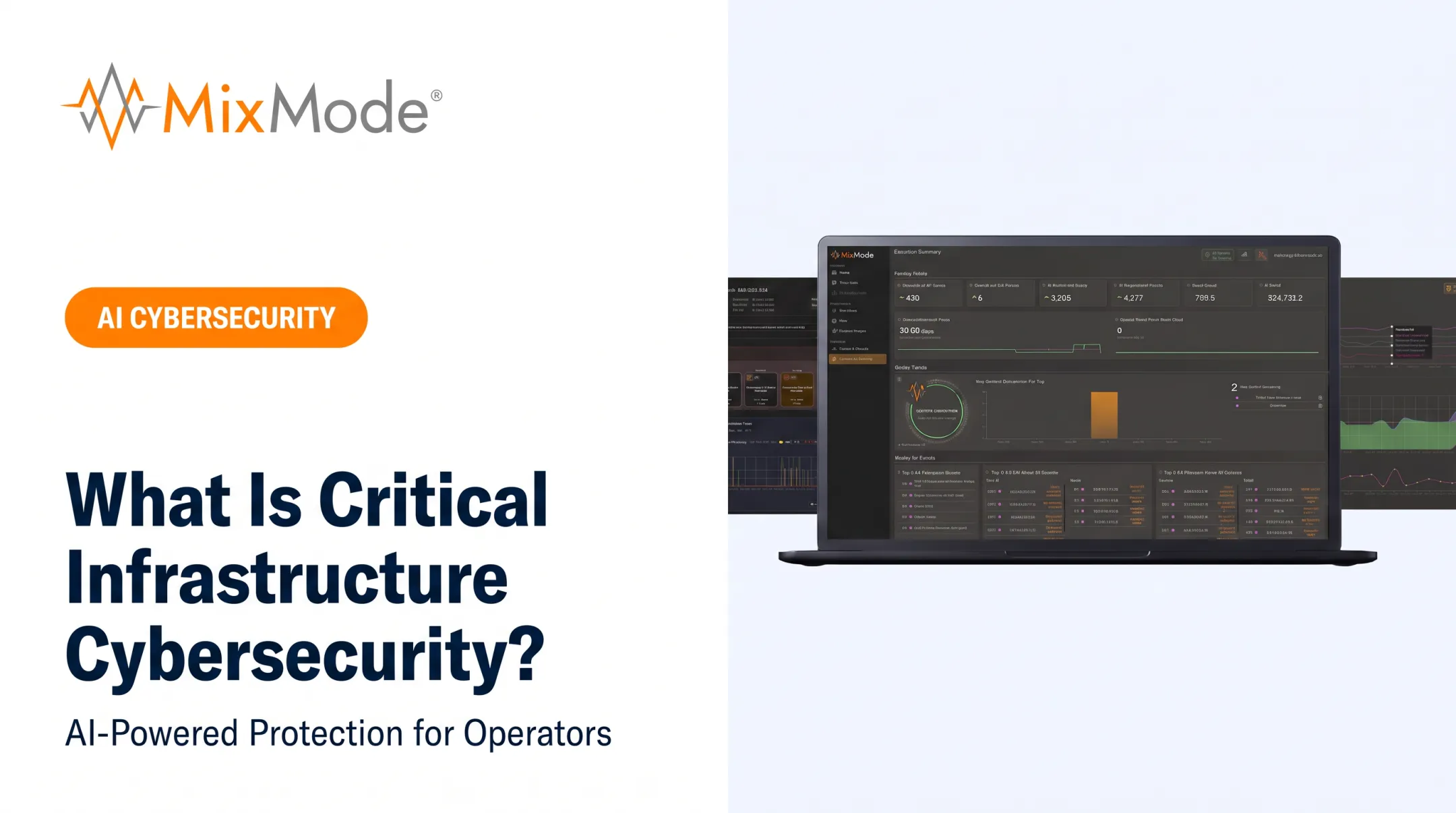
This is where MixMode's AI-first Cybersecurity Intelligence Layer plays a role — as one layer within a broader defense-in-depth strategy, not a replacement for the foundational controls above.
The platform deploys without appliances in under an hour and begins learning normal behavior within minutes, across cloud, hybrid, on-premises, edge, and air-gapped environments. One major U.S. utility reported immediate visibility into state-sponsored intrusions and adversarial AI activity after deployment, cutting false positives by more than 95%.
The City of Dallas now gets continuous visibility into north/south, east/west, and lateral network traffic through a single view. That matters when teams are stretched thin and alert fatigue is real.
For sectors where every minute of downtime matters, that kind of real-time, rules-free detection closes a gap that signature-based tools consistently miss.
Frequently Asked Questions
What is an example of critical infrastructure?
An electric grid is a classic example. Its disruption can cut power to hospitals, water treatment plants, and communications networks simultaneously, affecting public safety across multiple dependent systems.
What are the 16 sectors of critical infrastructure?
They include Energy, Water and Wastewater, Transportation, Dams, Chemical, Critical Manufacturing, Food and Agriculture, Commercial Facilities, Defense Industrial Base, Emergency Services, Government Facilities, Nuclear, Communications, Information Technology, Financial Services, and Healthcare and Public Health. Check current CISA guidance for official descriptions.
What is the difference between critical infrastructure and key resources?
"Key resources" was the older, broader DHS term referring to assets vital to national security and daily life. Today's framework replaces that umbrella term with the specific 16-sector classification system.
Why is critical infrastructure a cybersecurity concern?
Interconnected IT and OT systems, legacy technology, and remote access create entry points that threat actors actively exploit. A cyber incident in one of these sectors can directly disrupt physical, real-world services.
Who is responsible for protecting critical infrastructure?
Protection is a shared responsibility. Government agencies set standards and share intelligence, while private owners, operators, and their security teams handle day-to-day defense and investment.
How can organizations improve critical infrastructure resilience?
Start with asset visibility and risk assessment, then add segmentation, strong identity controls, and continuous detection. Pair that with tested incident response exercises and backup/recovery planning.