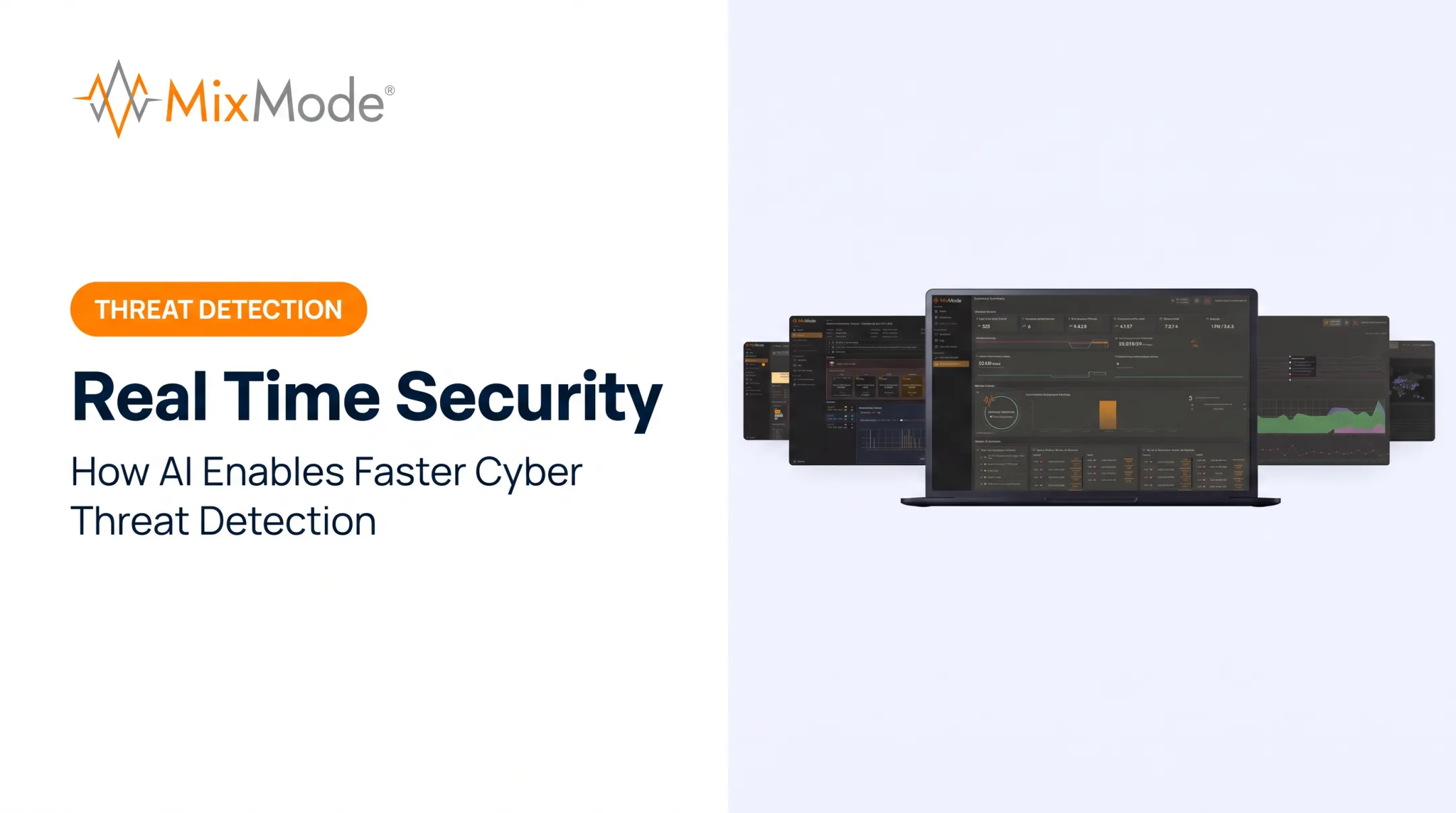
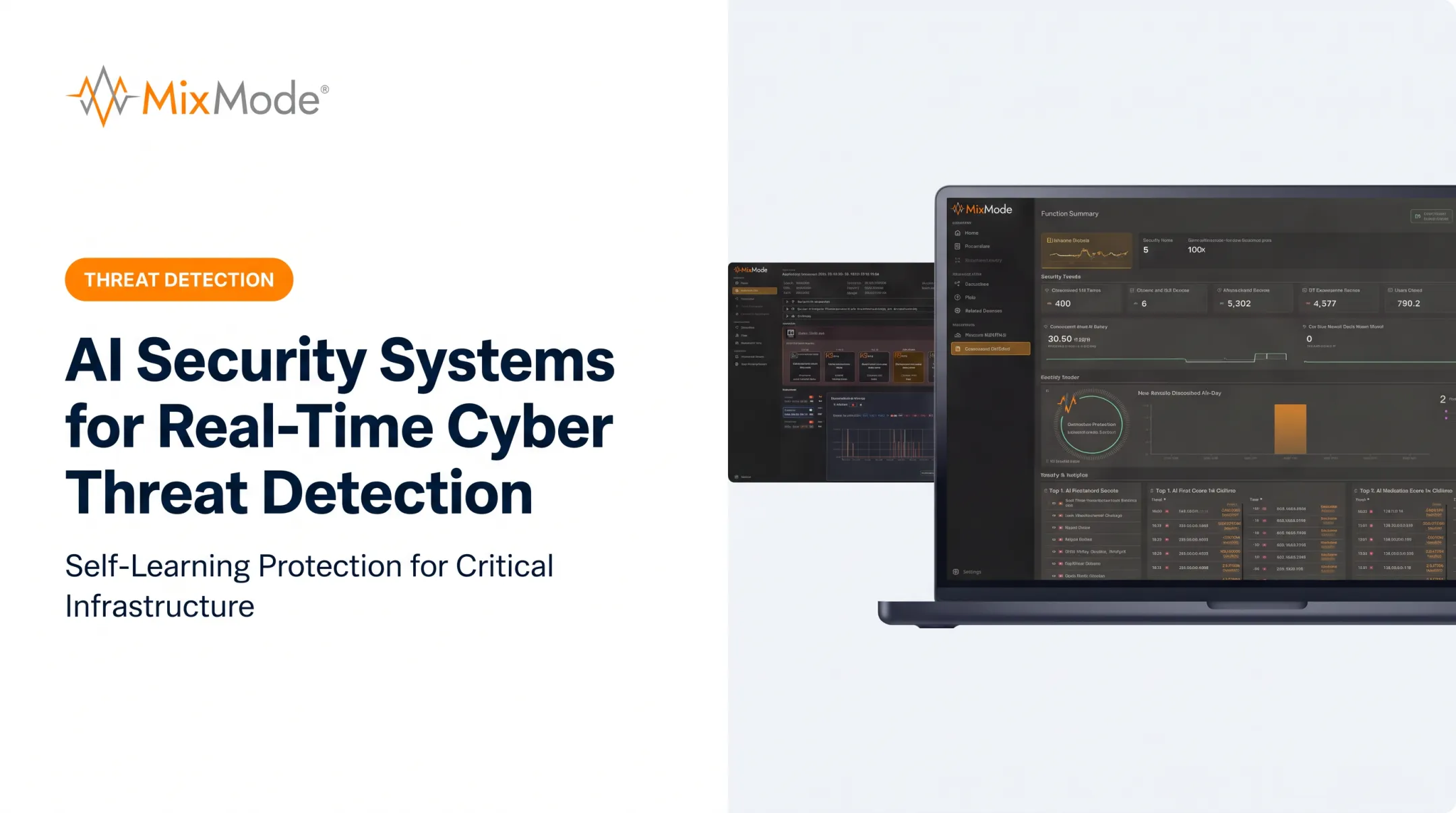
An AI-powered security system applies machine learning and related techniques to spot suspicious behavior, build context around it, rank what matters most, and help analysts respond to both familiar and unfamiliar threats. This isn't about replacing security teams. It's about giving them a faster, clearer picture of what's actually happening across their environment.
This article covers how real-time AI threat detection works, the core capabilities that matter, where enterprises and government agencies are putting it to use, and what to look for when evaluating a platform.
Key Takeaways
- AI-powered systems continuously analyze security data to flag deviations from expected behavior.
- Strong platforms pair known-threat detection with context-aware detection of novel activity.
- Evaluation should weigh data coverage, integration, deployment fit, and governance, not just AI buzzwords.
- The goal is reducing repetitive analyst work and alert noise while keeping humans in control of high-stakes decisions.
What Is an AI-Powered Security System?
In enterprise cybersecurity, an AI-powered security system refers to platforms that use machine learning, behavioral analytics, and automation to detect, investigate, and help respond to cyber threats. This is distinct from AI security cameras, smart-home monitoring, or tools built to secure AI models themselves.
There's an important difference between using AI for cybersecurity and securing AI:
- Using AI for cybersecurity means applying machine learning and behavioral analytics to detect, investigate, prevent, or respond to threats across an organization's network.
- Securing AI means protecting the models, training data, prompts, and integrations that power AI systems from manipulation, leakage, or misuse.
This article focuses on the former.
What Data Does It Analyze?
Enterprise-grade systems typically pull from multiple sources:
- Network traffic and flow logs
- Endpoint activity and process behavior
- Identity and authentication events
- Cloud telemetry (API calls, flow logs, configuration changes)
- Application behavior
- IT and operational technology (OT) signals
MixMode's platform, for example, ingests cloud, network, and endpoint data alongside Cloud API logs, flow logs, and packet captures, giving it visibility across IT, OT, ICS, and IoT environments.
AI Complements, Not Replaces, Existing Controls
AI-powered detection works alongside firewalls, endpoint detection and response (EDR), SIEM platforms, identity controls, and threat intelligence feeds. It doesn't make these tools obsolete. It adds a behavioral layer that catches what rule-based tools are structurally unable to see.
Set realistic expectations: AI improves speed, scale, and prioritization, but it still needs quality data, correct configuration, governance, and analyst validation to deliver value.
How an AI-Powered Security System Detects Threats in Real Time
Real-time detection follows a consistent lifecycle, regardless of vendor:
- Ingest and normalize data from network, endpoint, identity, cloud, and OT sources.
- Build an evolving picture of normal behavior across users, assets, and communications.
- Identify deviations — abnormal access, suspicious sequences, or unexpected combinations of events.
- Correlate related signals into a single contextual incident rather than dozens of isolated alerts.
- Prioritize findings by potential impact, confidence level, and asset importance.
- Route results to analysts or orchestration tools for investigation and response.
Signatures vs. Behavioral Detection
Signature-based detection is reliable for known indicators of compromise, but it struggles with novel malware, slow-moving attacks, and paths nobody has documented yet. The National Institute of Standards and Technology (NIST) describes anomaly-based detection as comparing current activity against established profiles of normal user, host, and network behavior. It flags statistically significant deviations rather than waiting for a known signature to match.
NIST also notes a real trade-off: complex anomaly alerts can be hard for analysts to explain or confirm as genuine threats. Context and explainability matter as much as the detection itself.
Behavioral models don't need a rule written for every possible attack variation. They learn what's normal for a specific environment and flag what isn't.
A Simple Example: How Low-Signal Events Become a High-Priority Incident
Picture this sequence over 36 hours:
- An external scan hits a handful of open ports (easy to dismiss alone)
- A service account logs in from an unusual location
- That account accesses a file server it's never touched before
- Permissions on that account change slightly
- A small but unusual data transfer occurs overnight
None of these events alone would trigger a rule-based alert. Correlated together, they describe a classic intrusion pattern: reconnaissance, compromised credentials, lateral movement, privilege escalation, and exfiltration. This is exactly the kind of chain that behavioral correlation is built to surface.

The Analyst Still Matters
AI should prioritize and enrich findings. Analysts still validate business context, judge severity, and coordinate response. Feedback from investigation outcomes helps refine detection quality as the environment changes — this is a partnership, not a handoff.
Core Capabilities and Benefits of AI-Powered Threat Detection
Context-Aware Anomaly Detection
The system compares activity against relevant users, assets, applications, locations, and time patterns. A database administrator accessing financial records at 2 a.m. during a scheduled migration looks different from an unfamiliar account doing the same thing with no change ticket attached. Context is what separates routine operations from potential compromise.
Detecting Known and Unknown Threats
Signatures and threat-intelligence feeds still matter for known indicators. Behavioral detection extends that coverage to activity that doesn't match any known pattern. MixMode's platform, for instance, builds behavioral models without relying on rules or historical training data, flagging activity that departs from its continuously updated expected-behavior baseline. Identifying suspicious deviations is not the same as guaranteeing every novel attack gets caught.
Alert Prioritization and Noise Reduction
Alert fatigue is a documented, widespread problem. Splunk's 2025 State of Security report, produced with Oxford Economics and surveying 2,058 security leaders across nine countries, found:
- 59% said they had too many alerts
- 55% said they had too many false positives
- Nearly half spent more time maintaining tools than defending the organization
Correlating events and adding asset context directly addresses this. One utility customer using MixMode's platform reduced its false-positive rate by more than 95%, freeing staff who had been stuck triaging noise to focus on real investigations.

Investigation and Response Acceleration
Event correlation, timelines, and natural-language summaries help analysts move from detection to triage faster. Integration with SIEM, SOAR, and ticketing platforms matters here. MixMode, for example, integrates with existing SIEM and orchestration tools rather than requiring teams to rip out what they've already built.
Scale Without Manual Review of Every Event
Modern enterprises generate telemetry at a scale that makes manual review impossible. Microsoft's Digital Defense Report shows its own reported security signals climbing from 65 trillion per day in 2023 to more than 100 trillion per day in its 2025 report (a vendor-wide figure, not a typical enterprise's log volume, but a clear illustration of why automation isn't optional anymore).
Platforms built for scale, like MixMode's, are designed to analyze over 100 Gbps of traffic or billions of records monthly without requiring a human to eyeball each event.
Industry and Operational Use Cases
Federal Agencies and Defense
Federal and defense networks face threats explicitly designed to blend in. CISA's 2024 advisory on Volt Typhoon describes PRC-sponsored actors pre-positioning on U.S. critical-infrastructure IT networks using legitimate system tools to avoid detection, a "living off the land" approach that signature-based tools aren't built to catch. Detecting this kind of activity requires context and adaptability, not just a longer list of known indicators.
Utilities, Energy, and Critical Infrastructure
Unified visibility across IT and OT environments matters because unusual communications or access patterns in these settings can create safety and availability risks, not just data-loss risk. Detection also needs to respect operational baselines, since normal industrial processes shouldn't trigger constant false alarms.
Case Study: City of Phoenix
The City of Phoenix needed stronger threat visibility for its Security Operations Center. MixMode was deployed remotely in under an hour, with no appliances required.
On day one, the platform detected threats that other tools and human operators had missed, and it became the core intelligence layer for the city's SOC going forward. In municipal and critical-infrastructure deployments, fast time-to-value matters as much as detection depth.
Manufacturing, Healthcare, Financial Services, and Enterprise SOCs
Common use cases across these sectors include:
- Ransomware detection before encryption completes
- Unusual access to sensitive patient or financial records
- Insider-risk indicators and lateral movement
- Cloud configuration anomalies
- Reducing alert overload for understaffed SOC teams
At a large financial services institution, MixMode identified an active attack within 72 hours , one that existing security tools had already missed. Each of these use cases ties back to the organization's specific data sources, risk tolerance, and available response resources.
How to Evaluate and Implement an AI-Powered Security System
Detection and Data Coverage
Ask which telemetry sources the platform actually supports and whether it correlates network, endpoint, identity, cloud, application, and OT activity — not just one or two of these. Push vendors to explain how they validate detection quality against both known threats and behavioral anomalies.
Deployment Flexibility
| Consideration | Why It Matters |
|---|---|
| Cloud / hybrid / on-premises | Matches existing infrastructure investment |
| Edge / air-gapped / DDIL | Required for disconnected or tactical environments |
| GPU dependency | Affects infrastructure footprint and deployment complexity |
| Deployment time | Faster time-to-value reduces risk exposure |
MixMode, for example, supports cloud, hybrid, on-premises, edge, air-gapped, and DDIL environments without requiring GPUs or appliances, with deployment possible in under an hour.
Integration and Analyst Workflow
Confirm compatibility with your existing SIEM, SOAR, ticketing, and identity tools. Check for solid APIs, event export, role-based access, and clear investigation timelines analysts can actually use under pressure.
Model Governance and Explainability
NIST's AI Risk Management Framework calls for defined human oversight, ongoing monitoring for model drift, and privacy-conscious design. Ask vendors:
- How are models trained and updated?
- How is drift monitored over time?
- Can analysts see why a specific alert was raised?
- What data retention and access controls are in place?
Measurable Outcomes and Operational Load
Establish baselines before you buy: alert volume, false-positive rate, mean-time-to-detect, and analyst capacity. Factor in integration, storage, training, and staffing demands, not just the capability list.

MixMode as One Example
MixMode is a self-learning, self-supervised Cybersecurity Intelligence Layer that detects known and unknown threats without rules or signatures. It connects to existing SIEM and orchestration platforms and fits the deployment profiles above. Score it against your own requirements; it is one option, not a universal fix.
A Practical Implementation Sequence
- Define priority use cases and success measures so the PoC has clear pass/fail criteria
- Map data sources and deployment constraints across cloud, on-prem, and OT environments
- Run a controlled proof of concept against live traffic and known baselines
- Tune workflows and integrations for SIEM, SOAR, and ticketing handoffs
- Train analysts and establish governance for model oversight and escalation
- Review outcomes on a set cadence and expand coverage based on evidence
Conclusion
An AI-powered security system earns its place when it turns a flood of changing security data into prioritized, contextual findings analysts can act on quickly, rather than simply adding another dashboard. Detection quality, data coverage, integration, deployment fit, governance, and measurable outcomes should drive your evaluation, not vague AI marketing language.
Resilience against known and emerging threats depends on combining adaptive AI with established controls, skilled analysts, and continuous evaluation. No single tool replaces that combination.
Frequently Asked Questions
How is AI used in cyber security?
AI applies machine learning, behavioral analytics, and automation to detect anomalies, prioritize alerts, accelerate investigations, and support identity security, fraud prevention, and vulnerability management across an organization's environment.
Which AI tool is best for cybersecurity?
The right tool depends on your data sources, use cases, deployment model, and SOC capacity. Compare verified capabilities and outcomes rather than choosing based on brand name or AI labeling alone.
What does NextGen security do?
"Next-generation security" broadly refers to adaptive, integrated technologies that improve detection and response through behavioral analysis, automation, and broader visibility. The term is vague, so evaluate specific capabilities instead of the label.
Can AI detect unknown cyber threats in real time?
AI can identify behavioral anomalies and attack patterns that don't match known signatures, but no system guarantees detection of every unknown threat. Data quality, context, and analyst validation all affect results.
How should organizations evaluate an AI-powered security system?
Look at data coverage, detection validation, false-positive handling, integration options, deployment flexibility, and governance. Measure operational load alongside concrete SOC outcomes, not just the feature list.