Introduction
Security teams face a real tension every day: they need visibility into what's happening on their network, but they also need to stop attacks before damage occurs. Waiting too long to act has a cost.
According to Mandiant's M-Trends 2025 report, the global median dwell time between intrusion and detection was 11 days in 2024. Internally detected incidents resolved faster (10 days) than those flagged by outside parties (16 days).
Intrusion detection systems (IDS) and intrusion prevention systems (IPS) address both sides of that problem. Both analyze network traffic for threats. The difference comes down to response.
An IDS watches and alerts. An IPS watches and acts. This article breaks down how each works, where they fit in your architecture, and how to decide which one (or both) your organization needs.
Key Takeaways
- IDS monitors and alerts; IPS monitors and can automatically block malicious traffic inline
- The core distinction is passive detection versus active prevention, not the threat types each tool catches
- IDS supports visibility, forensics, and rule tuning; IPS supports fast, automated containment
- Firewalls control what traffic enters the network; IDS/IPS inspect what gets through
- Most mature security programs run both, often starting with detection before enabling blocking
IDS vs. IPS: Quick Comparison
Here's how the two controls stack up across the factors that matter most for deployment planning.
| Factor | IDS | IPS |
|---|---|---|
| Primary purpose | Monitors traffic or activity and alerts security teams for investigation | Monitors traffic inline and automatically blocks, drops, or mitigates threats |
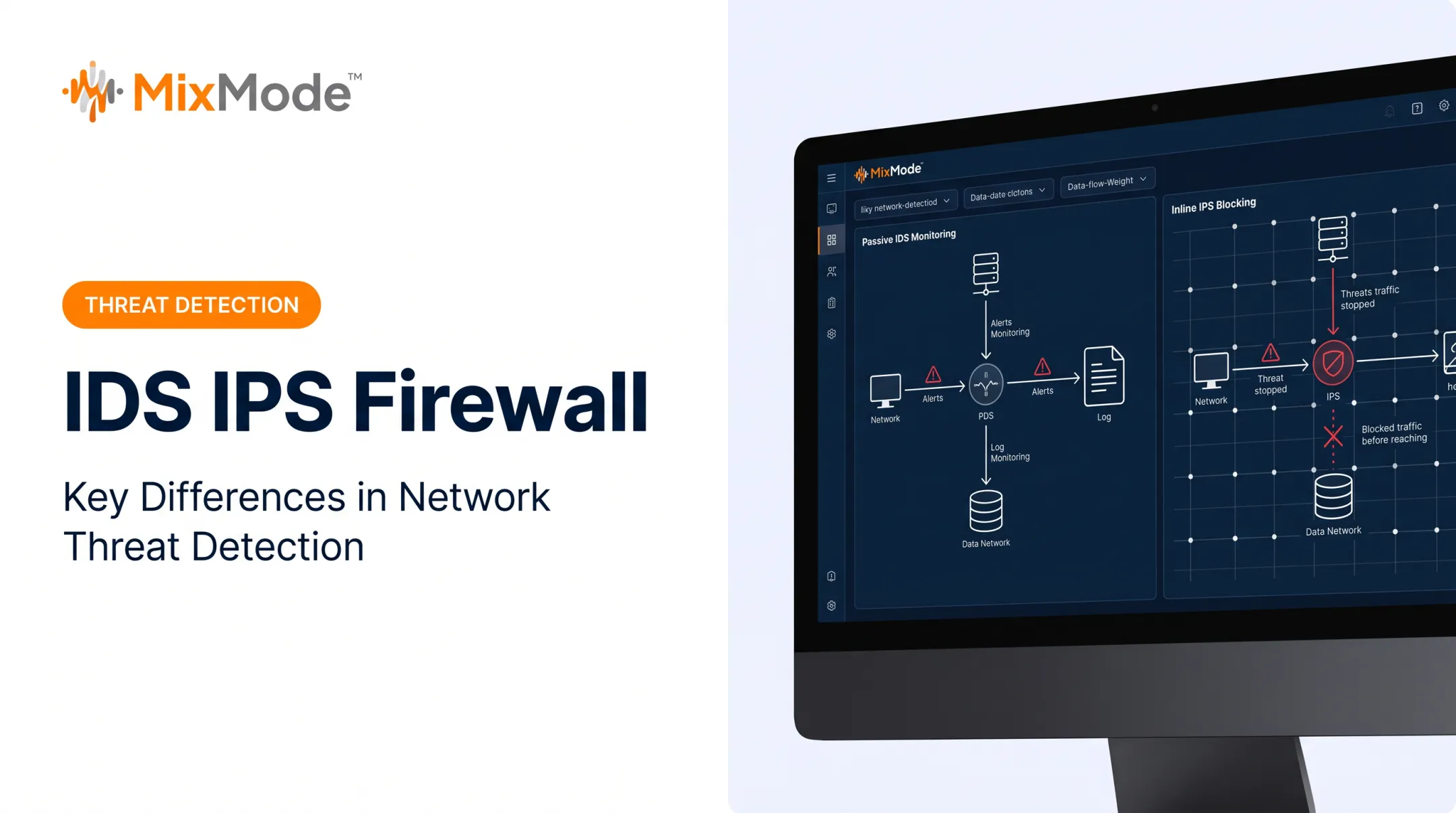
| Deployment position | Out of band, via a network TAP, SPAN port, mirrored traffic, or host telemetry | Inline, directly in the traffic path |
| Response to threats | Logs events and sends alerts to a SOC, SIEM, or monitoring platform | Applies configured actions: dropping packets, resetting connections, blocking sources |
| Operational impact | Doesn't disrupt traffic but can raise alert volume and analyst workload | Reduces manual response but requires careful sizing, tuning, and failover planning |
| Best-fit use cases | Baselining, threat hunting, forensic investigation, compliance monitoring | Real-time containment of known exploits, malware traffic, unauthorized access |
Both IDS and IPS can rely on signature-based, anomaly-based, or behavioral detection methods. Coverage depends heavily on configuration, network visibility, and the quality of the underlying detection logic, not just which category the tool falls into.
What Are IDS and IPS?
According to NIST Special Publication 800-94, an IDS automates the process of detecting intrusions, while an IPS has all the same detection capabilities plus the ability to attempt to stop the incident.
Intrusion Detection System (IDS)
An IDS observes network traffic, host activity, or system events, looking for known attack signatures, anomalies, and policy violations. The typical workflow looks like this:
- Collect traffic or log data from a network segment, host, or wireless channel
- Inspect relevant metadata or payloads against known patterns
- Compare activity to signatures or behavioral baselines
- Generate an alert when something matches or deviates
- Preserve event data so analysts can investigate further
Because it runs out of band, an IDS can sit in a sensitive or high-availability environment without touching the live traffic path. There's no risk of the monitoring tool itself causing an outage.
That visibility makes IDS valuable for:
- Threat hunting and forensic analysis
- Testing new detection rules before they go live
- Building a network behavioral baseline
- Supporting incident response investigations
The tradeoff is straightforward: an IDS does not stop the traffic it flags. A human analyst or a separate automated system has to act, which means the threat can keep moving while the alert sits in a queue.
IDS deployments typically fall into a few categories: network-based (NIDS), host-based (HIDS), wireless IDS, protocol-based variants, and hybrid setups that combine multiple detection approaches.
Intrusion Prevention System (IPS)
An IPS does everything an IDS does, then takes the next step. Sitting inline, it inspects traffic, classifies the activity, and applies a configured response automatically.
The workflow adds one critical step to the IDS process: enforcement. Traffic gets blocked, a session gets terminated, or a source gets isolated, all without waiting for a human to click approve.
That speed is the main selling point. But inline placement introduces real operational risk:
- Latency from inspecting every packet before it passes through
- False-positive blocking, where legitimate traffic gets dropped
- Availability concerns under high load
- Asymmetric routing issues, since Cisco notes its stream inspector struggles when it can't see both sides of a traffic flow
- The need for bypass and high-availability planning in case the inspection engine fails
IPS deployments come in similar flavors to IDS: network-based (NIPS), host-based (HIPS), wireless IPS, and IPS functionality built into next-generation firewalls.
Detection methods typically fall into three approaches:
- Signature-based: Catches known threats reliably but misses novel attacks
- Anomaly-based: Flags deviations from normal behavior to catch unknowns, though poorly tuned thresholds raise false positives
- Stateful protocol analysis: Checks traffic against expected protocol behavior and catches violations the other methods miss
How IDS and IPS Work Together
Most organizations don't flip a switch and go straight to full prevention mode. Cisco's documentation recommends a staged approach: run intrusion policies in alert-only mode first, identify which rules generate excessive false positives, then enable blocking once confidence is established, per Cisco's guidance on intrusion policy configuration.
That staged path generally looks like:

- Deploy in detection-only mode
- Establish a traffic and behavior baseline
- Validate alerts against known-good and known-bad traffic
- Tune policies to reduce noise
- Enable blocking for high-confidence detections only
Alerts and prevention events don't exist in isolation. They typically feed into a SIEM, a SOAR platform, endpoint security tools, and broader incident response workflows.
Modern next-generation firewalls often bundle firewall, IDS, and IPS functions into a single platform, but the underlying roles stay distinct: one observes, one enforces.
IDS vs. IPS: What Is Better for Your Organization?
Neither technology wins outright. The right answer depends on risk tolerance, staffing, how critical your traffic paths are, and how well you can validate automated decisions before trusting them.
Choose IDS or detection-only mode when:
- You need broad visibility before committing to automated action
- You're still establishing a behavioral baseline
- You're testing new signatures or policies
- Your systems are uptime-critical and can't tolerate a false-positive block
Choose IPS or prevention mode when:
- Rapid containment matters more than investigation time
- Your traffic paths are well understood and documented
- Your team can keep signatures and policies current
- The cost of a missed known threat outweighs the risk of an occasional false positive
Use both when your environment spans enterprise networks, hybrid cloud, government systems, utilities, manufacturing, healthcare, or converged IT/OT infrastructure. In those settings, investigation and immediate containment are both non-negotiable.
Selection also hinges on practical factors: deployment location, throughput and latency requirements, visibility into encrypted traffic, host versus network coverage, fail-open versus fail-closed behavior, high-availability design, SIEM integration, and how much staff time you have for policy management.
IDS and IPS don't replace firewalls, endpoint detection and response, identity controls, or vulnerability management. Each addresses a different layer.
This is also where rules-based detection starts to show its limits. Signature and even anomaly-based IDS/IPS depend on known patterns or defined thresholds. Organizations managing cloud, hybrid, on-premises, edge, or air-gapped environments often need broader context than static rules alone can provide. MixMode's Cybersecurity Intelligence Layer takes this approach, applying self-supervised AI that models network context continuously, without relying on rules, signature feeds, or historical training data, to flag both known and unknown activity alongside existing IDS/IPS controls.
A practical decision sequence:

- Map your critical assets and data flows
- Identify where telemetry or visibility gaps exist
- Define what automated actions you're willing to trust
- Run detection-only validation before enabling blocking
- Tune policies based on real alert data
- Enable prevention selectively, starting with high-confidence rules
- Measure outcomes: alert quality, response time, blocked threats, false positives, and availability
Real-World Examples and Deployment Scenarios
A major U.S. utility provides a useful case study in what happens when traditional monitoring tools can't keep pace with critical infrastructure demands. The utility was relying on a legacy SIEM platform for core network monitoring, a setup that generated high volumes of alerts without giving the security team confidence in what actually mattered.
The organization needed stronger visibility across its grid infrastructure without the operational risk of aggressive automated blocking in an OT-adjacent environment. That's a common constraint in utilities and energy.
NIST's OT security guidance recommends passive, out-of-band monitoring as a first step, because automated prevention can disrupt operational processes.
MixMode's AI-driven platform replaced the utility's previous SIEM for core network monitoring. The result:

- False positives dropped by more than 95%
- Security team gained clearer, more actionable visibility into real threats
- Analysts spent less time chasing noise and more time on investigation
The takeaway matches the broader IDS vs. IPS decision framework:
- Start with detection when visibility and validation come first
- Layer in prevention once automated blocking is trusted
- Use both when high-risk threats meet uptime-critical systems, such as a power grid
If your current IDS/IPS setup struggles with alert volume or can't surface unknown activity across cloud, hybrid, or OT environments, evaluate how MixMode's Cybersecurity Intelligence Layer complements the controls you already have.
Conclusion
IDS and IPS solve related but distinct problems. IDS gives you observation and alerting. IPS adds inline enforcement on top of that. For most organizations managing real risk, the strongest approach isn't picking one over the other. It's running a carefully tuned combination, often starting with detection and expanding into prevention as confidence grows.
Getting this right pays off in measurable ways:
- Better visibility into suspicious behavior
- Less alert fatigue for already-stretched analysts
- Faster containment when it counts
- Preserved uptime for systems that can't afford downtime
Before selecting or enabling either control, take stock of your traffic paths, detection coverage, response requirements, and tolerance for false positives. That assessment should drive the decision, not the other way around.
Frequently Asked Questions
What are IDS and IPS in networking?
An IDS is a passive system that monitors traffic or activity and alerts security teams when it spots something suspicious. An IPS does the same analysis but sits inline and can automatically block or disrupt malicious traffic.
Should I use an IDS or an IPS?
It depends on your visibility needs, automated response readiness, traffic criticality, and staffing. Many organizations use both, starting with IDS for baselining and moving to IPS for high-confidence threats.
What are the types of IDS and IPS?
Common types include network-based (NIDS/NIPS), host-based (HIDS/HIPS), wireless, and protocol-based variants. NIDS/NIPS monitor network segments, while HIDS/HIPS focus on individual host activity.
What is the role of IDS and IPS in a firewall?
A firewall filters traffic based on access rules, deciding what's allowed through. IDS and IPS then analyze that permitted traffic for malicious patterns. Next-generation firewalls often combine all three capabilities.
Can IDS and IPS work together?
Yes. Many organizations start with out-of-band detection to build a baseline and tune policies, then selectively enable inline prevention. Alerts and blocking events typically feed into a SIEM or orchestration platform.
What are the limitations of IDS and IPS?
Both struggle with encrypted traffic payloads, novel or slow-moving attacks, and false positives. They also lack deep endpoint or data-layer visibility, which is why they work best alongside complementary security controls.