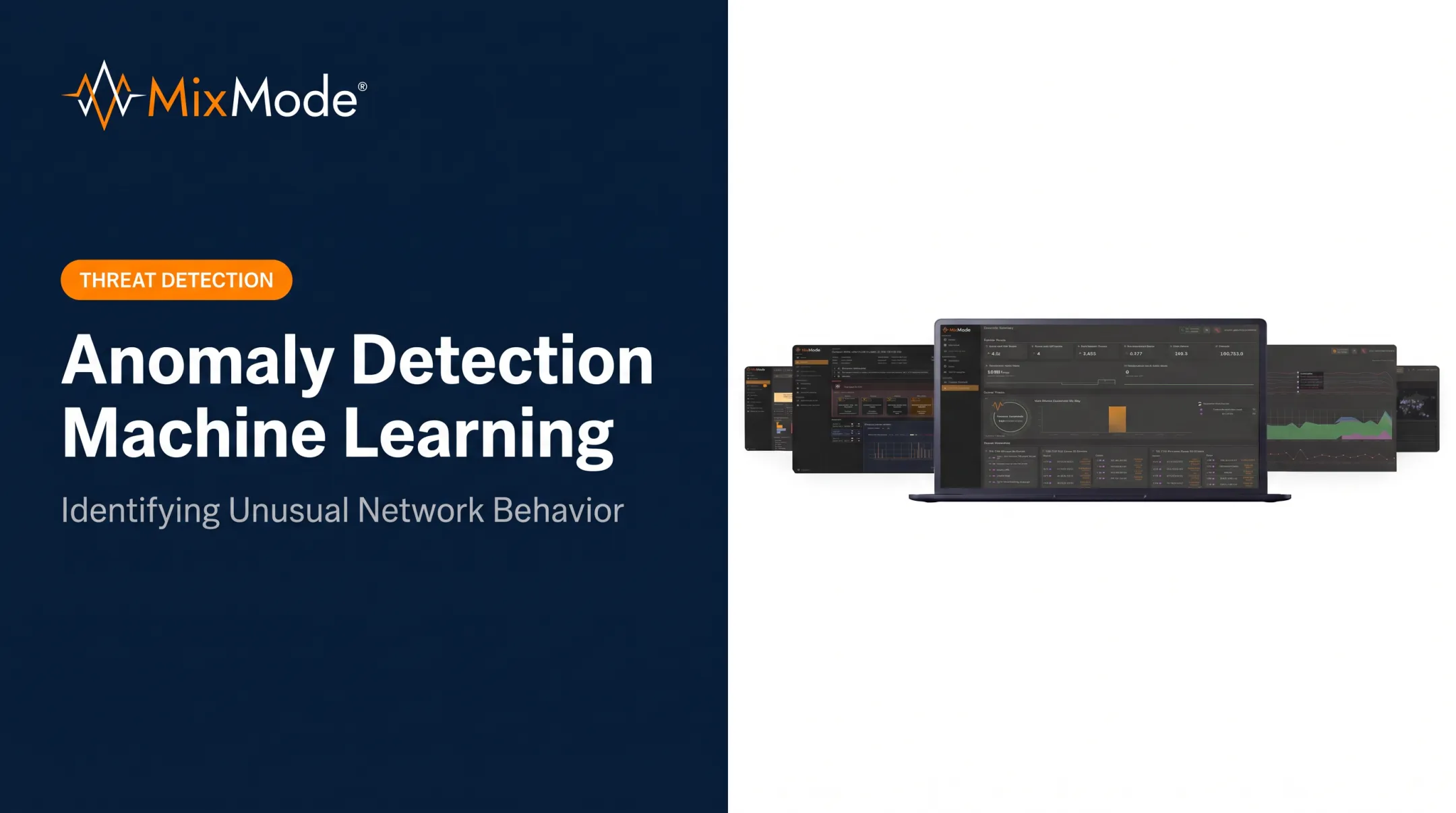
The challenge is that modern environments never sit still. New devices join networks, employees change roles, cloud workloads spin up and down, and attackers constantly retool. A signature database can't keep pace with all of it. Unusual activity isn't automatically an attack, but it's often the first thread worth pulling.
This guide breaks down what an anomaly-based intrusion detection system actually is, how it builds and evaluates a baseline of normal behavior, how it differs from signature-based tools, and where it fits inside a layered security program.
Key Takeaways
- Anomaly-based IDS flags deviations from a baseline of expected behavior, not only matches to known attack patterns.
- Surfaces unknown attacks, insider misuse, compromised accounts, and activity that signature tools often miss.
- Runs on telemetry collection, baseline creation, continuous analysis, anomaly scoring, alerting, and analyst review.
- Works best paired with signature-based tools, since deviations need context before anyone can call them malicious.
What Is Anomaly-Based Intrusion Detection?
An anomaly-based intrusion detection system monitors network, host, user, application, or system activity and flags meaningful deviations from what's expected. Rather than checking traffic against a list of known bad indicators, it builds a profile of normal activity and watches for departures from that profile.
NIST's guide to intrusion detection and prevention systems describes this directly: anomaly-based detection compares observed events against a definition of normal activity to find significant deviations, using profiles that can cover users, hosts, connections, or applications. A deviation is a lead for investigation, not confirmed proof of an attack.
This matters because signature-based detection, while effective against known threats, is largely ineffective against unknown ones. Zero-day exploits, modified malware, and novel techniques don't trip a signature match. Neither does a valid employee account being used in a way that's outside normal behavior.

A few clarifications upfront:
- "Anomaly-based" describes a detection method, while NIDS (network-based), HIDS (host-based), and hybrid IDS describe where monitoring happens. These categories overlap: a hybrid deployment can run anomaly-based detection across both network and host telemetry.
- An anomaly alert is not proof of an intrusion. It's a statistical outlier that requires human judgment.
- An IDS is not automatically an IPS. Detection and prevention are separate capabilities.
- Machine learning doesn't remove the need for analyst validation. It changes how the baseline gets built, not whether someone checks the output.
Common Anomaly Categories
Security teams generally group anomalies into three types:
- Point anomalies: a single event that breaks from the pattern, such as an unusually large data transfer from a workstation that normally sends small amounts of traffic.
- Contextual anomalies: an event that's only unusual given its context, like a login that's normal at 9 a.m. but suspicious at 3 a.m. for that specific user.
- Collective anomalies: a sequence of individually minor events that becomes suspicious as a group, such as a string of low-level access attempts across multiple systems in a short window.
How Does Anomaly-Based Intrusion Detection Work?
Anomaly-based IDS runs as a continuous cycle: gather telemetry, define expected behavior, compare new activity against that baseline, generate contextual alerts, and feed analyst feedback back into the system. Each stage shapes how accurate the next one can be.

Initiation and Data Collection
Data flows in from wherever the system has visibility : network flows, packet captures, DNS activity, authentication logs, endpoint events, cloud service logs, applications, and in some cases operational technology (OT) environments. What the system can actually see depends on where it's deployed.
A NIDS only sees traffic available at its network sensors, while a HIDS only observes activity on the host where it's installed.
CISA's red team advisory recommends monitoring authentication event codes and watching for deviations in who accesses which resource, from where, and when: exactly the kind of identity-aware context that makes raw telemetry usable.
Before analysis can happen, data needs normalization, deduplication, asset identification, user context, and time synchronization. Without that cleanup, comparing a cloud log timestamp to a firewall log timestamp is nearly meaningless.
Baseline Creation
The system builds a model of "normal" using historical activity, statistical patterns, behavioral profiles, machine learning, expert-defined rules, or some combination. That baseline can cover:
- Normal communication partners and traffic volumes
- Typical login times and locations
- Application behavior patterns
- Access frequency and device relationships
- Standard data-transfer patterns
Baselines aren't perfect from day one. Problems show up when there's insufficient training data, the training data is already contaminated with malicious activity, or a seasonal business change (say, quarter-end reporting) makes an otherwise normal spike look suspicious. New deployments and gradual baseline drift cause similar issues: either missed threats or a flood of unnecessary alerts.
MixMode's approach sidesteps part of this problem. Its generative AI begins learning immediately without requiring a pre-existing or historical baseline, adapting to both normal and anomalous behavior as data arrives rather than waiting weeks for an initial training period.
Continuous Comparison and Anomaly Scoring
Once a baseline exists, incoming activity gets compared against it and assigned a deviation score rather than a binary match/no-match verdict. A few practical examples:
- A privileged account suddenly accessing a system it's never touched before.
- A device initiating communication with an unfamiliar external destination.
- A sudden spike in east-west (internal) traffic between servers that rarely talk to each other.
Context changes everything here. The same deviation can mean something very different depending on identity, asset criticality, timing, geography, business purpose, and related events happening elsewhere on the network. An unusual login from a known traveling executive reads differently than the same login pattern from a service account that's never left one data center.
Alert Enrichment and Analyst Response
Raw anomaly scores aren't useful on their own. Mature systems group related events, attach asset and user context, show the supporting evidence, and route prioritized findings into a SOC, SIEM, or SOAR workflow for review.
From there, it's an analyst's job to determine whether the flagged activity is benign variation, a misconfiguration, a policy violation, or actual compromise. MixMode's Guided Response supports this step by providing remediation recommendations linked to threat intelligence and the MITRE ATT&CK framework, giving analysts a starting point instead of a blank investigation.
Detection and response are not the same thing. An IDS produces visibility and alerts. Blocking or containing a threat requires a separate control: an IPS, firewall rule, EDR action, SOAR automation, or a human decision to pull a device offline.
False positives remain a real operational cost industry-wide. The SANS 2025 Detection and Response Survey found that more than 60% of surveyed security teams encounter false positives "frequently" or "very frequently."
That's the kind of alert fatigue a well-tuned baseline is meant to reduce. MixMode customers have reported the platform's evolving baseline approach cutting false-positive rates by more than 95%.
Regulation, Tuning, and Feedback
Analysts don't set a baseline once and walk away. They tune thresholds, suppress known benign activity, update asset context, investigate recurring anomalies, and feed validated outcomes back into the model.
This matters more in environments that change constantly: cloud workloads that scale up and down, hybrid infrastructure, remote workforces, and converged IT/OT networks where "normal" shifts with production schedules.
MixMode's Cybersecurity Intelligence Layer is built around this kind of self-learning, context-aware approach, continuously updating its model of expected behavior rather than relying on a static profile that needs periodic manual retraining. It's one illustration of how a platform can support real-time detection without demanding constant hand-tuning, not a claim that every environment behaves identically.
Where Is Anomaly-Based IDS Used?
Anomaly-based detection shows up anywhere "normal" can be defined and monitored, which in practice is nearly everywhere.
Network and host environments. A NIDS can spot unusual traffic flows, scanning activity, lateral movement, and unexpected data transfers. A HIDS catches unexpected processes, unauthorized file changes, privilege escalation, or odd local access behavior. MixMode's platform identifies indicators across both layers, including reconnaissance, lateral movement, insider activity, and in-progress attacks, on enterprise networks, cloud platforms, and hybrid infrastructure.
Cloud, hybrid, and remote environments. Static assumptions about "normal" break down fast when workloads, identities, APIs, and access locations change by the hour. Effective detection here needs broad telemetry and identity-aware context rather than a fixed network map. MixMode provides adaptive detection across AWS and Microsoft Azure environments for exactly this reason.
High-consequence sectors. Federal agencies, financial services, healthcare systems, utilities, and manufacturing operators all depend on anomaly detection to catch what signatures miss, often where unusual activity has to be investigated without disrupting operations.
- Utilities and energy, where IT/OT convergence means an anomaly investigation can't risk taking production systems offline.
- Manufacturing, where unusual device behavior might signal ransomware moving laterally through a plant network.
- Healthcare, where connected medical devices expand the attack surface significantly.
- Government and defense, where sensitive, often air-gapped networks need detection that doesn't rely on constant external threat feeds.
MixMode supports this range through deployment flexibility across cloud, on-premises, edge, air-gapped, and tactical environments. That flexibility matters because critical-infrastructure and defense customers frequently can't rely on cloud-only tooling or constant internet connectivity.

Conclusion
Anomaly-based intrusion detection works by learning or defining expected behavior and flagging meaningful deviations from it, not by proving that every unusual event is an attack. That distinction is the whole point. It gives security teams a starting point for investigation that signature matching can't provide on its own.
Before adopting or expanding anomaly-based detection, assess a few things:
- Telemetry coverage and baseline quality
- How much context analysts get with each alert
- Integration with existing SIEM or SOAR tools
- Ongoing tuning requirements
- Deployment constraints like air-gapped or OT environments
None of this replaces signature-based tools or other layered defenses. It complements them, covering the blind spots those tools were never built to see.
Frequently Asked Questions
What is anomaly-based intrusion detection and how does it work?
It's a security control that builds a baseline of normal network, host, or user behavior and flags significant deviations from it. The process involves telemetry collection, baseline creation, continuous comparison, anomaly scoring, and analyst validation before any alert is treated as confirmed malicious activity.
What is the difference between signature-based and anomaly-based intrusion detection?
Signature-based detection matches activity against known malicious indicators, like file hashes or malicious IP addresses. Anomaly-based detection flags deviations from expected behavior instead, catching unknown threats that signatures can't. The two approaches work best together.
What are the main types of intrusion detection systems (IDS)?
The main categories are network-based (NIDS), host-based (HIDS), and hybrid IDS, which combines both vantage points. Each type can run signature-based, anomaly-based, or combined detection methods depending on the deployment.
What is signature-based detection?
Signature-based detection compares observed activity against known malicious patterns: hashes, domains, IP addresses, or other indicators of compromise. It's highly accurate for previously identified threats but largely ineffective against new or modified attacks.
What is the best tool for anomaly-based intrusion detection?
There's no single universal answer. The right tool depends on telemetry coverage, deployment environment, explainability of alerts, integration with existing SIEM/SOAR tools, tuning overhead, and scalability needs across your specific infrastructure.
What is an example of anomaly-based intrusion detection?
An example is a company account accessing systems it's never touched before, at a time outside its normal pattern, or a device suddenly communicating with an unfamiliar external destination. In both cases, an analyst still needs to confirm whether the activity is malicious or simply unusual.