Banks and insurers are attractive targets for an obvious reason: they sit on high-value identity and payment data while running on deeply interconnected technology stacks. A core banking platform, a claims processor, a loan origination tool, and a dozen vendors often share access to the same customer records. Add the requirement to keep services running 24/7, and the attack surface gets even wider.
This article covers the common causes behind financial-sector breaches, what happens when warning signs get ignored, how to detect trouble early, and the layered controls that actually reduce risk.
Key Takeaways
- Stolen credentials, unpatched software, cloud misconfigurations, insider mistakes, and third-party access drive most breaches, not advanced malware.
- Fallout includes fraud, account takeover, regulatory penalties, lawsuits, and customer churn.
- Combine identity, endpoint, cloud, and data-access signals for early detection instead of relying on one tool.
- Prevent breaches with least-privilege access, MFA, patching, segmentation, vendor oversight, and a tested incident response plan.
Common Causes of a Financial Services Data Breach
A data breach is not the same as a security incident, a data leak, or a fraud event. An incident is anything that could harm information assets; a breach specifically involves confirmed unauthorized access or exposure of sensitive data. Fraud is often the downstream result.
Most breaches don't trace back to one dramatic failure. They result from several smaller weaknesses stacking up: excessive access rights, poor visibility, delayed patching, or monitoring gaps that let suspicious activity go unnoticed for weeks.
Compromised Credentials, Phishing, and Account Takeover
Phishing emails, infostealer malware, password reuse, and credential stuffing all lead to the same outcome: an attacker logging in as someone else. That "someone else" might be an employee with access to a loan-processing system, a customer support agent who can reset account credentials, or a vendor with standing access to a cloud console.
Verizon's 2025 Data Breach Investigations Report analyzed 927 confirmed breaches in the financial and insurance sector. System intrusion, social engineering, and basic web application attacks together accounted for 74% of those breaches.
Stolen credentials repeatedly show up as a leading attack method, according to Verizon's 2025 DBIR financial services snapshot.
Unpatched Vulnerabilities and Insecure Applications
Attackers routinely scan for internet-facing software running outdated code, exposed APIs, or broken access controls. A single unpatched vulnerability can open a direct path into customer records.
The 2023 MOVEit incident shows how this plays out. CISA identified CVE-2023-34362, a SQL-injection flaw in MOVEit Transfer, as the vulnerability the CL0P ransomware group exploited starting in May 2023.
Insurer Genworth later confirmed that its vendor, PBI Research Services, held policyholder and agent files compromised through that same flaw. The exposure included Social Security numbers, dates of birth, and policy numbers before PBI applied the vendor's fix.
Effective vulnerability management needs:
- Continuous asset discovery, including vendor-managed systems
- Risk-based patch prioritization, not just "patch everything eventually"
- Secure development practices and regular penetration testing
- Verification that remediation actually closed the gap
Cloud Misconfiguration and Excessive Permissions
Not every breach involves malware. Publicly accessible storage buckets, overprivileged IAM roles, exposed secrets, and missing audit logs can expose massive data sets on their own.
Capital One's 2019 incident remains the clearest example. The company attributed unauthorized access to a specific infrastructure configuration vulnerability, affecting roughly 100 million people in the US.
Capital One noted that this type of vulnerability isn't unique to cloud environments. The OCC later assessed an $80 million civil penalty against the bank, citing inadequate risk assessment before its cloud migration.
Third-Party, Supply Chain, and Fourth-Party Exposure
A bank doesn't need its own systems breached to suffer a breach. If a processor, SaaS provider, or core-banking vendor gets compromised, the data they hold is just as exposed.
The 2023 Infosys McCamish incident illustrates vendor concentration risk well. A Maine attorney general filing linked the breach to Bank of America, affecting 57,028 people.
A separate Vermont filing identified Infosys McCamish as a third-party administrator for Principal Life Insurance, with ransomware encrypting certain vendor systems. One compromised vendor, multiple affected financial institutions.
Federal banking regulators addressed this directly in 2023 interagency guidance covering due diligence, contract terms, and ongoing monitoring throughout the vendor relationship, not just at onboarding.
Insider Activity, Human Error, and Accidental Exposure
Internal actors were associated with 22% of confirmed breaches in Verizon's financial and insurance dataset, a figure that covers both malicious insiders and accidental exposure, not deliberate theft alone.
A 2025 notice filed with the Massachusetts attorney general illustrates the point: TD Bank reported that an employee accessed customer information without a legitimate business purpose in November 2024, potentially exposing names, Social Security numbers, account numbers, and transaction data.
Access reviews, automated offboarding, and monitoring for unusual downloads catch this behavior before it spreads.

What Happens If a Financial Services Data Breach Is Ignored
An undetected breach rarely stays small. Attackers who maintain access tend to expand their footprint, pull more data, and sometimes disrupt operations outright.
IBM's 2025 Cost of a Data Breach study found a global mean of 241 days to identify and contain a breach, while Mandiant's 2025 M-Trends report put median attacker dwell time at 11 days. Those numbers measure different things, but both point to the same problem: time favors the attacker.
Financial and Operational Consequences
Incident investigation, system restoration, fraud reimbursement, credit monitoring, legal fees, and notification costs add up fast. IBM's 2025 research puts the average financial-industry breach cost at $5.56 million, a planning benchmark drawn from 600 organizations across 17 industries, according to IBM's 2025 Cost of a Data Breach Report.
Operational impact can hit just as hard. Fidelity National Financial's SEC filing after its November 2023 incident described blocking access to certain systems during containment, causing "varying levels of business disruption" and triggering notifications to roughly 1.3 million consumers.
Regulatory, Legal, and Contractual Exposure
US notification obligations depend on the institution type, data involved, and affected states. Legal counsel should determine specific deadlines, but the applicable frameworks generally include:
| Framework | Key requirement |
|---|---|
| FTC Safeguards Rule (GLBA) | Report qualifying breaches affecting 500+ consumers within 30 days of discovery |
| SEC Item 1.05 (public companies) | File Form 8-K within 4 business days of determining materiality |
| SEC Regulation S-P | Notify affected individuals within 30 days of awareness, for covered firms |
| NYDFS Part 500 | Notify within 72 hours of determining a reportable incident occurred |
| State breach laws | Vary by state; all 50 states plus DC have notification statutes |
| PCI DSS | Applies to any entity storing, processing, or transmitting cardholder data |
Beyond notification, institutions may face regulatory examinations, enforcement actions, class action lawsuits, and contractual disputes with affected vendors or partners.
Customer Fraud, Trust Loss, and Reputational Damage
Exposed identity and account data fuels account takeover, payment fraud, and targeted phishing against the very customers whose information was stolen. How an institution communicates after the fact matters almost as much as the breach itself.
A 2026 Integris survey of 1,000 US banking customers found 67% would consider switching institutions after a serious breach, a finding corroborated by the Integris Banking Trust and Technology Report. That's a stated intention, not confirmed churn, but it signals how fragile customer confidence becomes after a breach.

Warning Signs You're About to Experience a Financial Services Data Breach
These signals should trigger investigation, not confirm an active breach:
- Unusual identity activity — impossible-travel logins, repeated MFA prompts, unexpected privilege escalation, or new email forwarding rules
- Abnormal data behavior — bulk downloads, unusual database queries, access to dormant accounts, or unexpected changes to payment files
- Endpoint and network anomalies — suspicious processes, disabled security tools, lateral movement, or outbound traffic during unusual hours
- External warnings — vendor breach notifications, dark-web mentions of your data, or regulator inquiries
How to Prevent a Financial Services Data Breach
No single control eliminates breach risk. Prevention works as a layered program combining governance, identity security, data protection, continuous monitoring, vendor oversight, and a practiced response plan.
Strengthen Identity and Access Management
Foundation controls include:
- Phishing-resistant MFA and removal of stale accounts
- Least-privilege access for human and non-human identities
- Conditional access and time-bound privileges on service accounts, admin consoles, and vendor connections
Attackers increasingly target non-human identities, so start with privileged and internet-facing accounts, then expand coverage.
Discover, Classify, and Minimize Sensitive Data
You can't protect what you can't find. Inventory systems, vendors, and data stores that touch regulated financial information, then apply:
- Encryption in transit and at rest
- Tokenization where it fits the workflow
- Retention limits that teams actually enforce
Less stored data means a smaller breach footprint if something goes wrong.
Patch, Harden, and Segment Critical Environments
Prioritize remediation based on exploitability and the sensitivity of exposed data, not just CVSS scores. Segment payment environments, administrative systems, and backup infrastructure from everyday user networks to limit lateral movement if one system is compromised. Validate fixes through scanning and penetration testing, not just ticket closure.
Monitor Continuously and Detect Unknown Activity
Static rules and signatures struggle against novel attacks, low-and-slow insider misuse, and legitimate tools turned against you. Detection needs to connect a suspicious login with privilege changes and unusual data access across identity, endpoint, cloud, and network telemetry.
One large financial institution, despite spending over $100 million annually on cybersecurity, was fielding more than 55,000 network-traffic alerts every 15 minutes, most of them false positives. Adding cloud-flow and API monitoring pushed event volume past 500,000 per second, overwhelming its existing tools entirely.
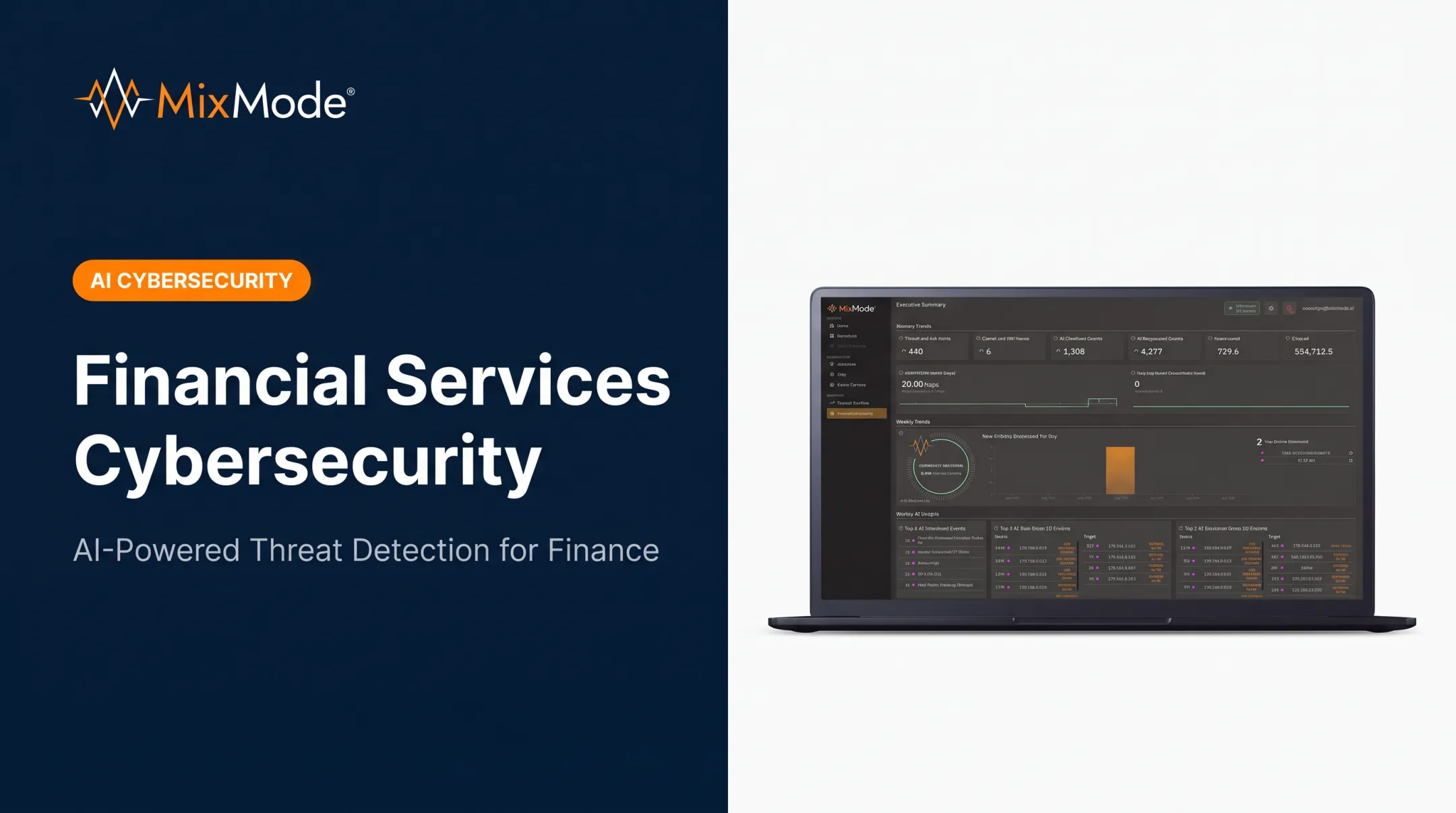
This is the gap MixMode's self-learning Cybersecurity Intelligence Layer was built to address. Rather than relying on static rules, it builds a continuously evolving model of normal network behavior and flags deviations, including pre-attack indicators and in-progress activity, across cloud, hybrid, on-premises, and air-gapped environments.
In the case above, the platform reduced false positives by more than 95% within the first week while analyzing over a million records per minute. It is a detection and visibility layer meant to integrate with existing SIEM tools, not a replacement for human investigation.
Manage Vendors and Prepare the Response
Treat third parties as part of the control surface:
- Assess vendor access scope, subcontractors, and incident-notification commitments before onboarding, then review them on a set cadence
- Maintain a response team spanning security, legal, communications, and key vendor contacts
- Run tabletop exercises for ransomware, cloud compromise, and third-party breach scenarios, then update the plan based on what breaks

Tips for Long-Term Prevention and Control
Sustained security requires routine discipline, not a one-time project.
Routine Monitoring and Checks
Review these areas on a defined schedule:
- Privileged access and dormant accounts
- Vendor connections and cloud configurations
Track time to detect, time to contain, and unresolved critical exposures as recurring metrics.
Training and Operator Standards
Role-based training matters more than generic annual sessions:
- Developers need secure coding practices
- Customer service teams need payment-change verification steps
- Executives need to recognize targeted social engineering
Systematic Documentation
Keep these current:
- Data-flow maps and vendor registers
- Incident playbooks and regulatory contacts
Documentation that's accurate during an actual incident saves hours when every hour counts.
Using Technology and Automation
Centralized logging, behavioral analytics, and automated access reviews reduce alert fatigue and surface what matters.
Automation should support investigation and decision-making, not replace the judgment of trained analysts.
Conclusion
Financial services breaches follow identifiable pathways: compromised credentials, unpatched software, cloud misconfiguration, insider exposure, and third-party access. None of these require a sophisticated nation-state actor, though those threats exist too.
Prevention is an ongoing discipline, not a project with an end date. Focus on the fundamentals:
- Maintain accurate visibility into your systems
- Reduce unnecessary access
- Watch for behavioral changes across identity and data
- Validate your vendors
- Rehearse your response before you need it
Detection that surfaces both known and unknown threats before they escalate gives security teams lead time that static, rules-based tools struggle to provide.
Frequently Asked Questions
How much compensation will I get for a data breach?
Compensation isn't automatic. It depends on the specific breach, documented harm, any settlement terms, and applicable law. Review the organization's official notice and consult qualified legal counsel for advice on your situation.
How do I check if my data was breached?
Look for official breach notifications from the affected organization, check state attorney general breach notice pages, and monitor your accounts and credit reports. Be cautious of unsolicited messages claiming to be breach alerts.
What is a financial breach?
A financial services data breach is unauthorized access, exposure, theft, or disclosure of financial or personal information held by a bank, insurer, lender, or their service provider.
What are the most common causes of financial data breaches?
Common causes include compromised credentials, phishing, unpatched vulnerabilities, cloud misconfiguration, excessive permissions, insider activity, and third-party compromise. Causes vary by incident.
How can financial institutions prevent data breaches?
Layered prevention includes MFA and least-privilege access, consistent patching, network segmentation, encryption, employee training, vendor oversight, and continuous monitoring paired with a tested incident response plan.