Introduction
A security analyst sees a suspicious connection attempt at 2 a.m. Should the system just log it and send an alert, or should it block the traffic immediately before anyone even looks?
That tension between visibility and automatic intervention sits at the heart of the IDS vs. IPS debate.
An intrusion detection system (IDS) watches network or host activity and raises an alarm. An intrusion prevention system (IPS) goes a step further, sitting inline and actively blocking what it flags as malicious.
For U.S. enterprises, federal agencies, utilities, manufacturers, and healthcare organizations, this isn't a minor technical choice. Blocking the wrong traffic on a hospital network or a power grid can cause real harm.
According to the 2025 SANS Detection and Response Survey, security professionals rated intrusion detection and prevention tools as "extremely effective" just 19% of the time, with 59% calling them merely "effective." That gap is exactly what this article addresses: definitions, deployment models, detection methods, and how to decide what your organization actually needs.
Key Takeaways
- IDS monitors and alerts; IPS sits inline and can block, drop, or quarantine traffic automatically.
- False positives cost IDS teams analyst time; false positives in IPS can cut off legitimate business traffic.
- Both rely on signature, anomaly, or behavioral detection, but placement and tuning determine real-world coverage.
- Most mature security programs run both, layered with SIEM and behavioral AI for deeper context.
IDS vs. IPS: Quick Comparison
Before going deeper, here's how the two systems stack up side by side.
| Factor | IDS | IPS |
|---|---|---|
| Action taken | Alerts and logs; no interruption | Blocks, drops, resets, or quarantines |
| Placement | Out-of-band, passive (monitors a copy of traffic) | Inline, sits directly in the traffic path |
| Primary value | Visibility, forensic evidence, analyst control | Fast, automated containment |
| False-positive impact | Analyst fatigue, wasted investigation time | Blocked legitimate users or applications |
| Best suited for | Investigation, OT networks, sensitive systems | High-confidence, well-understood threats |
Detection and Response
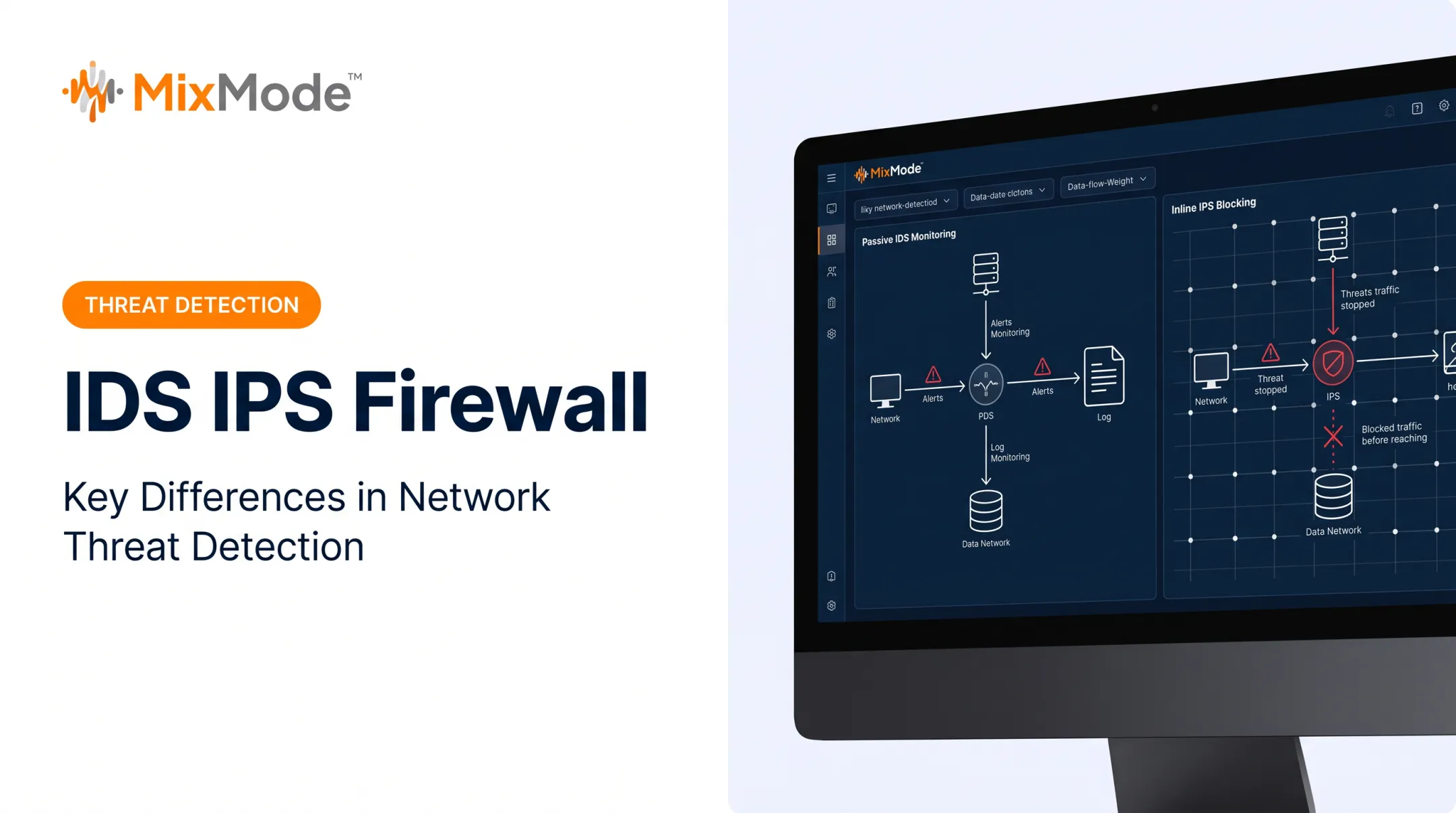
IDS observes traffic or host activity, records the relevant evidence, and sends an alert for a human (or automated playbook) to review. Nothing gets interrupted in real time.
IPS does the same inspection, then acts. It can drop packets, block a source address, terminate a session, or quarantine an endpoint, often within milliseconds.
Deployment Position
IDS typically runs out-of-band. A network tap or spanning port feeds it a copy of traffic, so the sensor never sits between the user and their destination.
NIST's guide to intrusion detection and prevention systems confirms that passive sensors inspect this copy, not the live stream, which means they can't reliably stop traffic before it arrives.
IPS is different by design. It sits inline, directly in the traffic path, specifically so it can block something before it reaches its target.
False-Positive Impact and Governance
This is where the two systems diverge most sharply in day-to-day operations.
- IDS false positive: Consumes analyst attention, adds to the alert queue, contributes to burnout.
- IPS false positive: Can block a legitimate customer transaction, a vendor connection, or a clinical device, with real business consequences.
That's why IPS demands rigorous tuning, staged testing, exception handling, and rollback procedures before you flip the switch to active blocking.
Detection Scope and Integration
Both systems can run signature-based or anomaly-based detection, but coverage depends heavily on where they sit. Network-based tools miss what happens on the host; host-based tools miss what happens on the wire.
Encrypted traffic limits visibility for both unless decryption is in place. Integration with firewalls, SIEM platforms, and orchestration tools turns raw alerts into a usable security workflow.
What Is an IDS?
An intrusion detection system collects network packets, flows, host events, or log data and analyzes it for signs of suspicious activity. When it finds something, it generates an alert. It doesn't act on its own.
Two main detection approaches power IDS:
- Signature-based detection: matches activity against known attack patterns. Fast and accurate for known threats, but blind to anything new.
- Anomaly or behavioral detection: builds a baseline of "normal" and flags deviations. Better at catching novel threats, but requires an accurate baseline to avoid noise.
Forms of IDS
- Network-based IDS (NIDS): Watches traffic across a segment or boundary.
- Host-based IDS (HIDS): Monitors activity on a specific server or endpoint.
- Wireless or protocol-focused IDS: Covers specialized traffic types firewalls often miss.
- Hybrid deployments: Combine network and host visibility for broader coverage.
A typical IDS alert includes a severity or confidence score, timestamp, affected asset, traffic details, and retained logs: everything an analyst needs to triage and investigate without guessing.
Where IDS Excels
IDS is the right call when interruption simply isn't an option: passive monitoring of sensitive networks, post-incident investigation, and baselining normal behavior before you ever consider blocking anything.
Alert volume makes that harder than ever. Internally, MixMode has observed enterprise networks generating 55,000+ alerts every 15 minutes, with cloud and API monitoring adding another 500,000+ events per second. Traditional rules-based systems that only catch known signatures simply can't scale to that volume without drowning analysts in noise.

Use Cases of IDS
- Enterprise SOC monitoring: Spotting reconnaissance, unusual lateral movement, suspicious outbound connections, and policy violations before they escalate.
- Critical infrastructure and healthcare: Passive monitoring protects utilities, manufacturers, and hospitals where inline blocking could disrupt operational technology or patient-facing systems.
- Forensic investigation: Retained logs and traffic details support after-the-fact root-cause analysis.
Main limitations:
- Depends entirely on analyst follow-through: an alert nobody reads does nothing
- Can generate overwhelming alert volume
- Blind spots in encrypted or unmonitored segments
- Weak against threats with no known signature
What Is an IPS?
An intrusion prevention system combines detection with an automated, policy-driven response. The goal: stop malicious activity before it spreads or does damage, not just report on it afterward.
Common IPS actions include:
- Dropping packets or resetting connections
- Blocking a source or destination address
- Terminating an active session
- Rate limiting suspicious traffic
- Isolating an affected asset (where supported)
Forms and Deployment Modes
IPS comes in network-based, host-based, and wireless variants, plus network-behavior analysis tools that evaluate traffic patterns at scale. Placement determines what each can actually see and act on.
The bigger decision is inline versus out-of-band deployment. Inline mode gives you blocking power but introduces latency and throughput questions. Security teams also need to decide on fail-open versus fail-closed behavior — does traffic pass uninspected if the IPS process fails, or does it stop entirely? Cisco's own configuration documentation treats a software-process failure separately from a hardware power loss, and getting that distinction wrong can mean an unplanned outage or an unmonitored gap.

Operational Risks
IPS isn't risk-free. False positives, overly broad blocking rules, policy conflicts, and encrypted traffic inspection challenges all demand ongoing tuning — not a one-time setup.
IPS works well against:
- Known exploits and malware callbacks
- Brute-force login attempts
- Unauthorized protocol usage
- Certain denial-of-service patterns
Where IPS hits a wall: CISA's guidance on DDoS mitigation notes that on-premises solutions are highly unlikely to have the bandwidth or compute capacity to mitigate a large volumetric DDoS attack. Local circuit and hardware limits cap what any on-prem IPS can absorb — upstream scrubbing providers are built for that scale instead.
Use Cases of IPS
IPS suits organizations with limited analyst capacity, heavy exposure to known threats, or a genuine need for rapid containment — as long as response policies are carefully governed, not set once and forgotten.
A sound implementation sequence looks like this:
- Map assets and traffic flows before touching any blocking rules
- Build a behavioral baseline over several weeks
- Run in alert-only mode to validate accuracy
- Move to staged blocking, starting with high-confidence rules
- Build exception handling for known-good traffic
- Review performance and false-positive rates regularly
IPS protects internet-facing services and network boundaries well. It's less effective against lateral movement inside the network — that's where host, endpoint, identity, and behavioral controls need to pick up the slack.
IDS vs. IPS: What Is Better?
Neither system wins outright. IDS prioritizes visibility and analyst control. IPS prioritizes speed and automated containment. Most mature security architectures use both, in different places, for different purposes.
Quick decision guide:
- Choose IDS when disruption could threaten safety, production, patient care, or mission continuity.
- Choose IPS when blocking well-understood threats matters more than the risk of interrupting legitimate traffic — and your team can keep policies accurate.
- Use both when you need enforcement at high-confidence boundaries plus deeper monitoring for investigation and lateral movement.
Evaluation Checklist
Before choosing (or re-architecting), walk through:
- What assets need protection, and where do they sit on the network?
- Does your cloud/hybrid architecture support inline inspection?
- Do you need host coverage, network coverage, or both?
- How much encrypted traffic will blind your detection?
- Can your team handle the throughput without latency issues?
- What's your staffing capacity for tuning and incident response?
- What compliance requirements apply?
- Who approves automated blocking, and how do you roll it back if it breaks something?
Where Context-Aware AI Fits In
Here's the gap both IDS and IPS share: they're generally built around known patterns — signatures, rules, or a static behavioral baseline. That's a problem when the threat has never been seen before.
MixMode operates differently. It functions as a self-learning Cybersecurity Intelligence Layer that continuously models network behavior instead of relying on static rules or signatures. It integrates with existing SIEM platforms and orchestration engines rather than replacing IDS or IPS outright, helping security teams surface pre-attack indicators and abnormal activity across cloud, on-premises, and even air-gapped environments. For organizations already running IDS and IPS, this kind of layer adds the "what we've never seen before" piece that signature-based tools structurally can't cover.

Real-World Example: Visibility First, Then Action
Brazilian utility CPFL Energia had a visibility problem — some substations hadn't been physically checked in months, making it nearly impossible to assess or remediate vulnerabilities across the grid.
CPFL deployed Cisco Cyber Vision embedded in industrial switches to identify connected devices and monitor communications across its operational technology network, with separate traffic filtering layered between substations and control centers. The result: Cyber Vision identified more than 20 malware cases inside CPFL's OT environment that had previously gone unseen.
The lesson isn't that prevention is unnecessary — it's that you can't automatically block what you can't see first. Visibility and containment work together, not as competing priorities.
Conclusion
The core difference is simple: IDS tells you something suspicious is happening. IPS tries to stop it.
Neither is automatically the "better" choice. The right architecture depends on:
- Risk tolerance
- Where traffic actually flows
- How mature your response process is
- How much operational disruption your organization can absorb
A manufacturing floor and a SaaS application don't have the same tolerance for a false positive.
Layer IDS, IPS, SIEM, endpoint, identity, and behavioral detection together where your environment calls for it.
One internal MixMode finding is worth considering: 75% of organizations that forward identity log sources to their SIEM don't actually use them for threat detection. Collecting data and acting on it are two very different things.
If your current IDS/IPS and SIEM stack isn't surfacing unknown threats fast enough, evaluate whether a behavioral AI layer could close that gap.
Frequently Asked Questions
What are IDS and IPS systems?
An IDS detects suspicious network or host activity and alerts security teams without interrupting traffic. An IPS performs the same detection but can actively block or mitigate the activity in real time.
Is IDS or IPS better?
Neither is universally better. IDS suits environments where visibility and analyst control matter most; IPS suits situations demanding fast, automated containment. Many organizations run both.
Is IDS/IPS the same as a firewall?
No. Firewalls enforce access-control policy based on rules like ports and IP addresses. IDS/IPS tools identify attack patterns or suspicious behavior and may alert or block depending on configuration.
What are three types of firewalls?
Packet-filtering (stateless), stateful inspection, and application-proxy (application-layer) firewalls are the three classic categories. Modern next-generation firewalls often combine these with IPS capabilities.
What does IDS stand for?
IDS stands for Intrusion Detection System. It monitors network or host activity and alerts administrators to suspicious behavior without taking direct action.
Can an IDS and IPS be used at the same time?
Yes. Many organizations use IPS for high-confidence, real-time blocking at network boundaries while running IDS for passive visibility and investigation where inline blocking would be too disruptive.