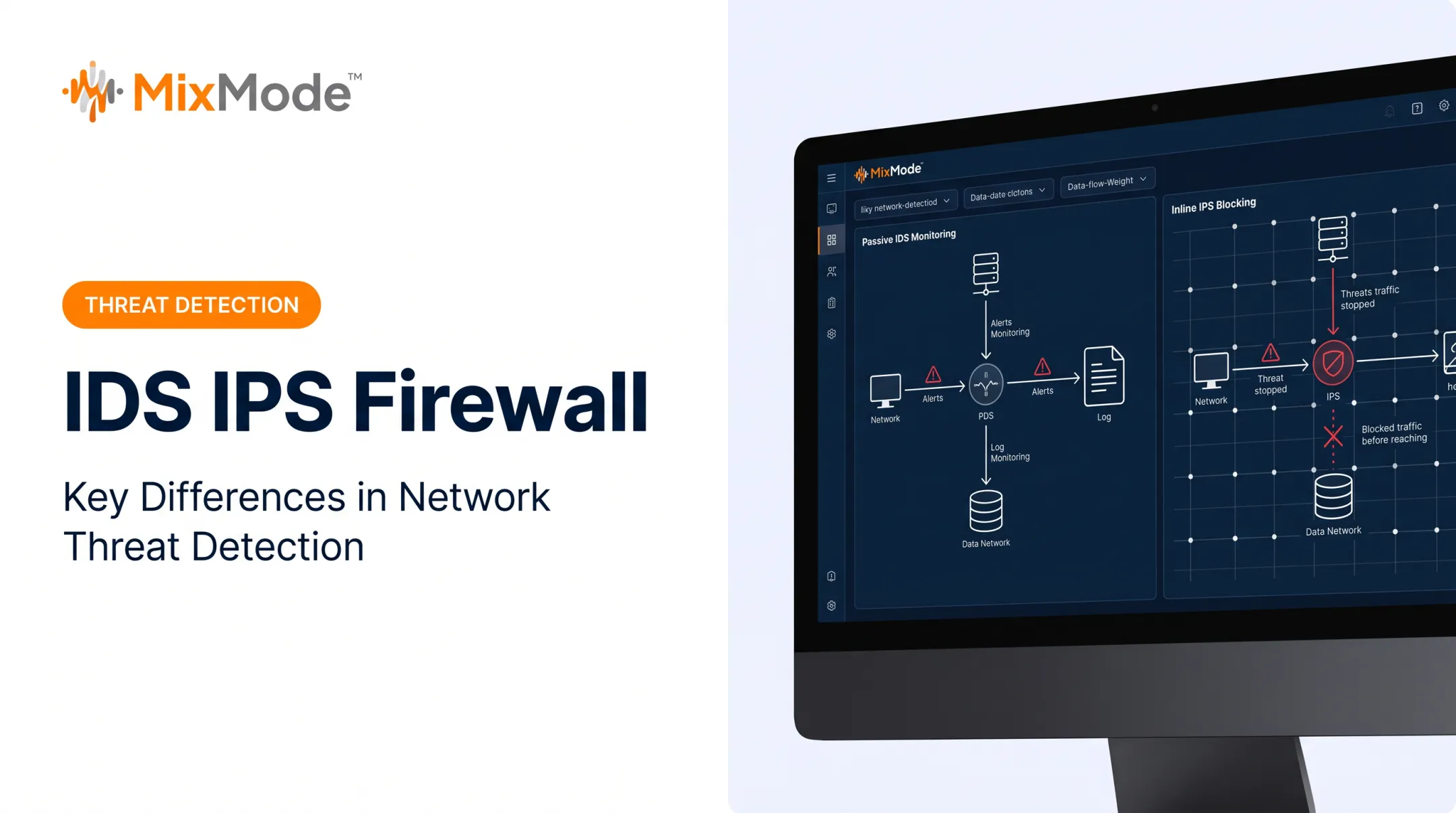
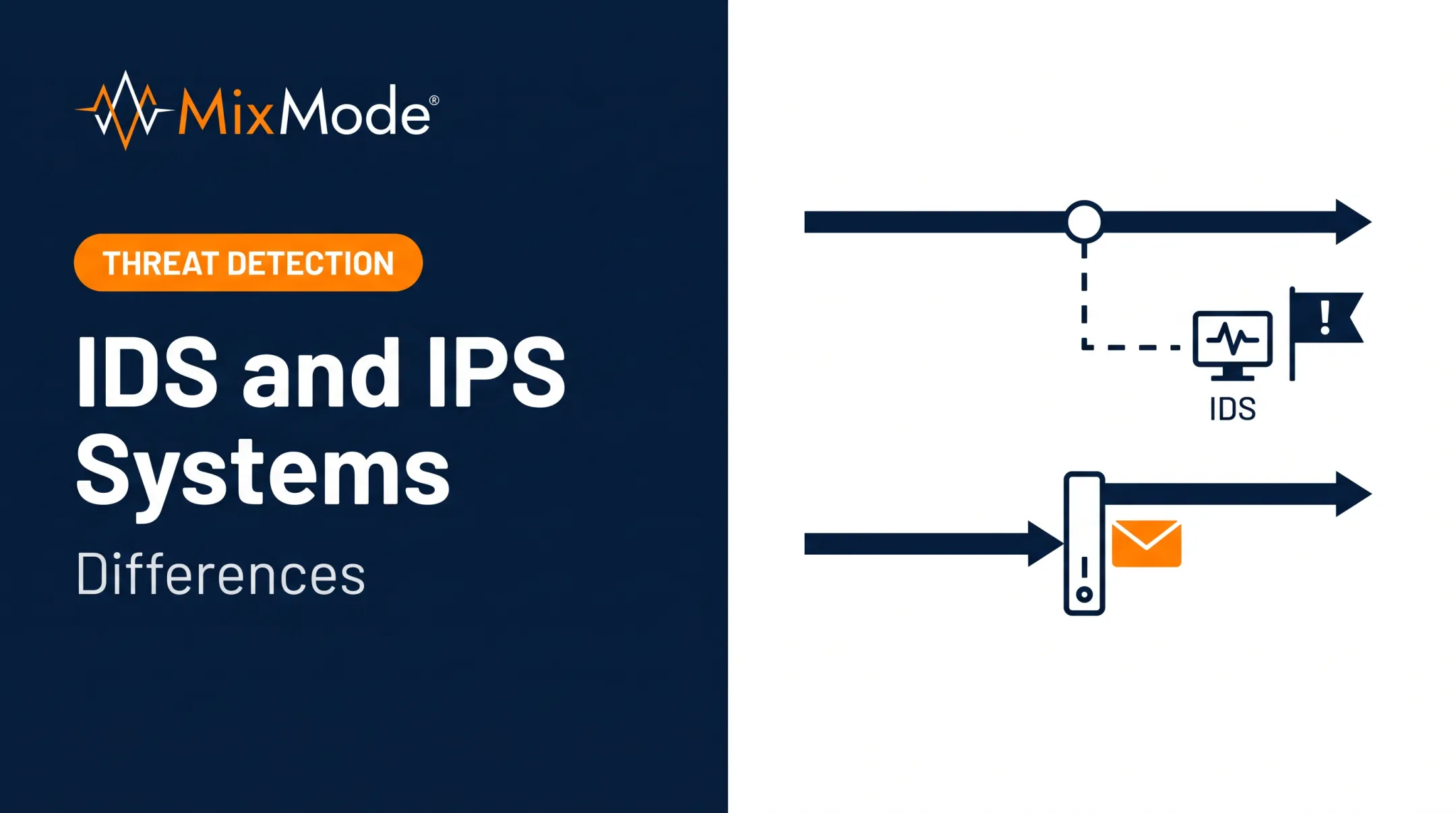
IPS inspects traffic in the path and can drop packets, reset sessions, or block connections the moment it spots a known exploit. Network Detection and Response (NDR) takes a different approach, watching network behavior over time to surface the suspicious activity that has already slipped past perimeter controls.
This distinction matters for enterprises, government agencies, utilities, manufacturers, and healthcare organizations dealing with alert overload, encrypted traffic, and lateral movement risk. The short answer: NDR and IPS do different jobs. The strongest architectures use IPS for inline prevention and NDR for behavioral detection, investigation, and response.
Key Takeaways
- IPS blocks known threats inline; NDR detects suspicious and unknown network behavior.
- NDR provides investigation context and timelines; IPS prioritizes immediate enforcement.
- Pair both with firewalls, EDR, SIEM, and identity controls; neither works alone.
- Choose based on your visibility gaps, tolerance for inline disruption, and analyst capacity.
NDR vs. IPS: Quick Comparison
Here's how the two technologies stack up across the dimensions that matter most for architecture decisions.
| Dimension | NDR | IPS |
|---|---|---|
| Purpose | Detects, investigates, and supports response to suspicious network behavior, including activity with no known signature | Prevents or disrupts detected threats by inspecting traffic inline and enforcing blocking policies |
| Detection approach | Network telemetry, behavioral analytics, machine learning, and contextual correlation (capabilities vary by vendor) | Signature matching, exploit and protocol analysis, policy rules, and sometimes anomaly detection |
| Network position | Often receives mirrored, flow, or packet telemetry without sitting directly in the traffic path (Gartner notes inline operation is optional for NDR) | Typically operates inline to make real-time enforcement decisions, which raises availability and false-blocking considerations |
| Response | Prioritized findings, investigation context, and threat timelines, often via SIEM/SOAR integration | Drops packets, terminates sessions, rejects connections, or applies configured prevention actions |
| Best-fit role | Broad visibility, threat hunting, unknown-threat detection, lateral movement analysis, post-compromise investigation | Immediate prevention of known exploits, malicious traffic, and policy violations |
The position row matters more than it looks. An NDR platform watching a mirrored copy of traffic can't accidentally break a production application. An IPS sitting inline can, which is exactly why it's built to act fast and why its design trades some flexibility for speed.

What Are NDR and IPS?
Network Detection and Response (NDR)
NDR continuously analyzes network communications and related telemetry to flag suspicious behavior, including activity that doesn't match a known signature. It builds a baseline of what normal traffic looks like for a given environment, then highlights deviations: unusual connections, unexpected admin behavior, credential misuse, abnormal data movement, or command-and-control patterns.
Instead of treating every event as an isolated alert, NDR correlates activity across time, users, devices, and network segments. That correlation is what turns a handful of disconnected log entries into a usable investigation lead.
NDR's documented SOC value includes:
- Earlier detection of reconnaissance, lateral movement, and insider activity
- Reduced alert fatigue through behavioral baselining instead of rule stacking
- Faster investigation via correlated event timelines
- Visibility across cloud, hybrid, on-premises, IT, and OT environments
Not every NDR product detects every zero-day or fully decrypts encrypted sessions. Capabilities depend on the telemetry and analytics the vendor uses, so verify what a given platform actually ingests before assuming coverage.
Use Cases of NDR
NDR earns its value after an attacker gets past the perimeter. Common scenarios include:
- Large enterprise SOC: correlating lateral movement across thousands of endpoints without manually chasing every signature alert
- Municipal or federal environment with limited analyst capacity: City of Dallas uses NDR to hunt threats and investigate lateral movement across on-prem and cloud when staffing can't keep pace with growth
- OT or critical-infrastructure environment: passive visibility into converged IT/OT traffic without risking operational continuity
NDR also integrates with SIEM, SOAR, firewalls, and identity systems, so a network-level finding can automatically trigger a containment workflow rather than sitting in a queue.
Intrusion Prevention System (IPS)
IPS is an inline control that inspects traffic and takes a configured action the moment it identifies malicious, unauthorized, or policy-violating activity. According to NIST SP 800-94, common detection methods include signature matching, protocol analysis, policy enforcement, and — in some products — anomaly detection.
Typical IPS actions:
- Dropping packets or rejecting connections
- Blocking source addresses
- Terminating or resetting sessions
- Quarantining traffic (depending on architecture)
IPS strengths are speed and consistency: it stops known attacks without waiting for an analyst to respond. The trade-off is real too. NIST's guidance points out that inspection without access to plaintext can't catch attacks hidden inside encrypted payloads, and high traffic loads can prevent full analysis. Tuning is a constant balancing act between false positives and false negatives.
Use Cases of IPS
IPS earns its place at the perimeter and at segmentation points where immediate blocking has clear value:
- Known exploit attempts: signatures stop recognized attack patterns before they execute
- Malicious scanning and worms: automated propagation gets cut off at the inline point
- Brute-force patterns: repeated login attempts against SSH, RDP, or HTTPS services
- Unauthorized protocol activity: traffic violating defined network policy
High-volume environments benefit from this kind of automated enforcement, but it requires change control, testing, and a fail-safe plan. An IPS misconfiguration can block legitimate traffic just as easily as malicious traffic.
Used alongside NDR, the division of labor is straightforward: IPS blocks what it can identify in line, while NDR monitors broader behavior and investigates whatever gets through or around it.

NDR vs. IPS: Which Is Better?
Neither one. They answer different questions. IPS answers "can I stop this traffic right now?" NDR answers "what is actually happening across my network, including the things I haven't seen before?"
Choose IPS when:
- Immediate inline blocking of known or policy-defined threats is the priority
- The traffic path is well understood and consistent
- The team can support ongoing tuning and availability planning
Choose NDR when:
- Broad network visibility and behavioral detection matter more than instant blocking
- Threat hunting, investigation, and lateral movement analysis are priorities
- You need to catch activity that evades signature-based prevention
Use both for defense in depth. IPS supplies enforcement at defined chokepoints while NDR supplies context across internal, cloud, hybrid, and OT environments that are harder to instrument inline.
A practical evaluation checklist before choosing a platform:
- What traffic and metadata does it actually see?
- Does it work in connected and disconnected environments?
- How does it handle encrypted communications — metadata analysis or payload inspection?
- What SIEM, SOAR, firewall, or identity integrations are available?
- How are detections prioritized, and does that match your analyst bandwidth?
- How will you measure success — reduced investigation time, fewer alerts, faster containment?
MixMode's Cybersecurity Intelligence Layer is a self-learning, AI-first alternative to rule-based detection, built to complement IPS rather than replace it. The platform models network context continuously and flags both known and previously unseen activity without static signatures or months of baselining. For organizations running IPS at the perimeter but lacking visibility into east-west traffic, that behavioral layer fills a gap IPS was never designed to cover.
Real-World Examples and Deployment Scenarios
Verified incidents make the architecture argument clearer than theory does.
A 2023 CISA red team assessment found that a critical-infrastructure organization's existing controls, including its intrusion detection and prevention systems, failed to detect a red team's lateral movement and command-and-control activity between geographically separated sites.
CISA's recommendation afterward: establish a baseline of normal traffic and tune detection for anomalous behavior, effectively adding the behavioral layer that inline prevention alone doesn't provide.
That gap shows up in deployment decisions across sectors:
- Government: The City of Phoenix deployed MixMode remotely, with no appliances, in under an hour, and the platform detected threats on day one that prior tools and their operators had missed.
- Financial services: At a bank running rule-based platforms, MixMode surfaced active, novel attacks that existing tools hadn't flagged, while ingesting hundreds of billions of cloud flow logs and API records.
- Utilities: Organizations running MixMode across utility networks report earlier identification of insider threats, lateral movement, and advanced attacks, the post-perimeter visibility gap IPS isn't designed to fill.
A quick scenario comparison: an internet-facing web application protecting customer logins benefits most from IPS enforcement blocking brute-force and exploit traffic at the edge.
A segmented utility or government network, by contrast, needs NDR to catch unusual internal behavior that never crosses an inline inspection point in the first place.

The practical takeaway: assign each technology a clear role, then validate coverage across the full attack path, not just the entry point. If your current setup can't tell you what happened after a threat got past the perimeter, that's a visibility gap worth closing. Connect with MixMode to evaluate whether its AI-driven Cybersecurity Intelligence Layer closes that gap for your environment.
Conclusion
IPS and NDR aren't interchangeable alternatives. They're different tools solving different problems. IPS acts on traffic it recognizes, inline, in real time. NDR reveals and contextualizes the suspicious behavior that happens across the broader network, including activity no signature was ever written for.
Getting this right translates directly into outcomes that matter: faster detection, fewer wasted alerts, reduced lateral movement risk, and more resilient defenses across enterprise, government, cloud, hybrid, and critical-infrastructure environments alike.
Frequently Asked Questions
How is NDR different from EDR?
NDR focuses on network communications and traffic behavior, while EDR monitors activity on individual endpoints like laptops and servers. They're complementary — attacks often span both devices and network paths, so investigating one without the other leaves gaps.
What are the four types of IPS?
NIST's classification framework names four categories: network-based, host-based, wireless, and network behavior analysis-based. Classifications can vary slightly depending on the framework or vendor describing them.
Does NDR replace IPS?
No. NDR generally doesn't perform inline prevention. It complements IPS by detecting suspicious behavior, providing investigation context, and catching activity that bypasses or evades preventive controls entirely.
Can NDR prevent network attacks?
NDR is primarily detection- and response-focused, but many platforms can trigger or recommend containment through integrations with firewalls, SOAR platforms, or identity systems. Exact capabilities vary by product.
Should an organization use NDR and IPS together?
Yes, in most layered architectures. IPS handles immediate blocking of recognizable threats at defined chokepoints, while NDR provides the broader behavioral visibility needed for threat hunting and investigating activity that prevention alone misses.